
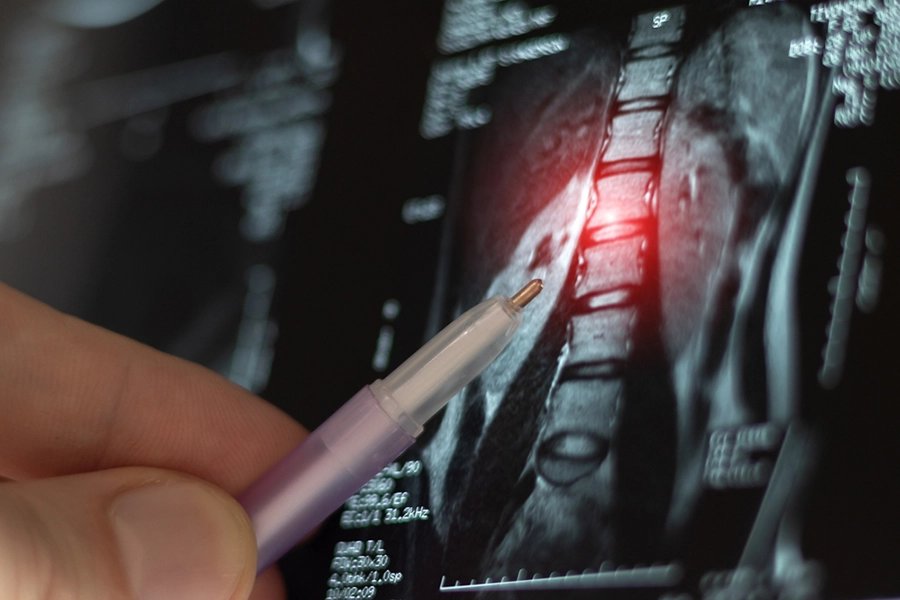
Discography: A Diagnostic Test for Finding the Source of Back Pain
Discography Quick Facts
- What it does: Discography, also called a discogram, is a diagnostic tool that helps determine whether a specific spinal disc is causing back pain when symptoms and imaging do not tell the full story.
- How it works: A spine specialist injects contrast dye into one or more discs while using imaging guidance. If the pressure reproduces your familiar pain and dye movement shows disc disruption, the disc may be contributing to your symptoms.
- Why it matters: MRI scans can show disc degeneration, herniations, or tears, but they do not always prove which disc is painful. Discography adds functional information by testing how the disc responds.
- How it guides care: Results can help your physician decide whether non-surgical care, regenerative medicine, disc replacement, spinal fusion, or another treatment pathway is most appropriate.
You’ve lived with back pain for a long time, and might have been recently diagnosed with a spinal condition. In order for a spine specialist to determine the optimal treatment plan for you, they’ll need to identify the source of your pain. An effective and studied way of doing this is by performing a discography.
What is a Discography?
Discography is a diagnostic spine procedure used to help identify whether a spinal disc is the source of chronic back pain. This test involves placing a thin needle into the center of a spinal disc and injecting contrast dye while the physician monitors the disc under imaging guidance. The dye can reveal whether the disc has structural damage, such as a tear or leakage pattern, and the pressure from the injection may reproduce the patient’s typical pain. The test also helps determine the internal structure of the disc, which helps later determine the treatment path.
As Dr. Ehsan Jazini explained in a patient case, “just because the disc doesn’t look normal doesn’t mean it’s painful.” That is why discography can be valuable when MRI findings alone do not fully explain a patient’s symptoms.
Discography may be considered when:
- Back pain has persisted despite non-surgical care
- MRI findings show degenerative discs, disc tears, or herniations
- Several discs look abnormal and the pain source is unclear
- A physician needs more information before recommending a procedure or surgery
- Prior spine treatment has not resolved symptoms
How Can Discography Help Identify Where Back Pain Is Coming From?
Discography helps identify back pain by testing whether pressure inside a spinal disc reproduces the patient’s familiar symptoms. During a physical exam, a physician can press on muscles, joints, and other structures to see what triggers pain. However, a spinal disc cannot be directly evaluated from the outside of the body. Discography provides a way to evaluate the disc more directly. A helpful way to understand the test is this: an MRI shows what the disc looks like, while discography helps ask whether that disc hurts when it is challenged. When the test reproduces the same pain the patient experiences in daily life, that response can help confirm the disc as a likely pain generator.
The most meaningful finding is called “concordant pain”. Concordant pain means the test reproduces the same chronic back pain the patient feels in daily life. That detail helps confirm that a structural disc problem is likely causing the symptoms.
Anatomy of a Disc
A spinal disc is a cushion between the vertebrae that helps absorb shock, support motion, and maintain spacing in the spine. Each disc has a soft center, called the nucleus pulposus, and a tougher outer ring, called the annulus fibrosus. The inside of a healthy disc has limited pain sensation, but the outer annulus contains nerve fibers that can become irritated when the disc is damaged. When a disc degenerates, tears, or becomes disrupted, inflammatory chemicals and mechanical stress can irritate pain-sensitive nerve endings in the outer disc. This is one reason degenerative disc disease, annular tears, and disc herniations can contribute to chronic back pain in some patients.
How is a Discography Performed?
During discography, contrast dye is injected into the center of one or more spinal discs while the physician uses imaging to observe the disc structure and pain response.
The procedure typically includes these steps:
- Preparation: The patient is positioned so the physician can safely access the disc being tested.
- Needle placement: Using imaging guidance, the physician places a thin needle into the disc.
- Contrast injection: Dye is injected into the disc to evaluate its structure.
- Pain response assessment: The patient reports whether the injection reproduces their usual back pain.
- Control testing: Nearby discs that appear normal may be tested as controls to confirm they are not contributing to symptoms.
A healthy disc should generally accept a small amount of dye without reproducing the patient’s typical pain. A damaged disc may reproduce familiar pain and may show dye leaking through a tear or disrupted area, as Dr. Christopher Good explains in his video on the discography test:
What Do Discography Results Show?
Discography results can show whether a disc is structurally damaged, whether it reproduces the patient’s familiar pain, and how much dye the disc can hold. The amount of dye a disc accepts may help the physician evaluate its structural competence. A disc that holds dye normally may be more structurally intact. A disc that accepts dye abnormally or allows dye to escape may have a tear, rupture, or degeneration, as Dr. Jazini explains in his ‘Discography Insights Pt. 2‘ video continuation.
The most useful result is not simply whether a disc looks abnormal. The key question is whether the tested disc reproduces the same pain that brought the patient to the spine specialist. This helps the spine surgeon determine which disc is most likely responsible for symptoms.
What Happens If Discography Finds an Unhealthy Disc?
If discography identifies a painful or unhealthy disc, the next step is to match treatment to the patient’s diagnosis, anatomy, symptoms, and goals. The use of discography allows the physician to identify the source of pain, which then helps develop the optimal treatment plan for each patient. The goal is not to treat every degenerative disc, but treat the ones that are causing the pain.
Treatment options may include:
- Spine-specialized physical therapy and activity modification
- Medications or targeted injections
- Regenerative medicine options, such as stem cell therapy for low back pain
- Motion-preserving procedures when appropriate
- Spinal fusion when the painful disc is severely damaged or unstable
- Revision surgery strategies for patients with persistent pain after prior spine surgery
At VSI, treatment planning is individualized. The goal is to identify the disc or discs causing pain and build a personalized plan that helps restore function, reduce symptoms, and support a return to an active lifestyle. Our belief is to treat our patients with the most comprehensive care possible. Our team will coordinate an individualized treatment plan to restore you to a full and active lifestyle.
Is Discography Right for Everyone With Back Pain?
Discography is not necessary for every person with back pain. Many patients can be diagnosed with a physical exam, medical history, X-rays, MRI, or other diagnostic tools. Discography is typically reserved for select cases where symptoms persist, imaging is inconclusive, or a physician needs more information before recommending a targeted treatment. A spine specialist can determine whether discography is appropriate based on your pain pattern, imaging results, prior treatments, and medical history.
At VSI, the emphasis is on treating the patient, not just the imaging. This philosophy guides how VSI evaluates chronic back pain.
Ultimately, we want to treat the patient, not the picture.
Dr. Ehsan jazini
When Should You See a Spine Specialist for Chronic Back Pain?
You should see a spine specialist if back pain lasts for several weeks, limits daily activity, travels into the legs, causes numbness or weakness, or does not improve with conservative care. Long-term back pain can have many causes, including muscle strain, arthritis, nerve compression, disc degeneration, disc herniation, or spinal instability. The right diagnosis is essential because the best treatment depends on the true source of pain. Our spine specialists use a comprehensive diagnostic approach to understand what is causing your pain and which treatment options are most likely to help.
Discography is not needed for every person with back pain. Many patients can be diagnosed through medical history, physical examination, X-rays, MRI, CT scans, or other diagnostic tools. However, when the source of pain is unclear and multiple discs are in question, discography may provide important information for the patient’s path to full recovery.
FAQ: Discography and Back Pain Diagnosis
Is a discography the same as an MRI?
No. An MRI shows the structure of the spine, while discography tests whether a specific disc may be causing pain. MRI is often an important first step because it can show disc degeneration, herniation, narrowing, and nerve compression. Discography may be used when the MRI findings need to be correlated more directly with the patient’s symptoms.
Does a discogram diagnose degenerative disc disease?
A discogram can help evaluate whether a degenerative disc is painful, but it is not the only test used to diagnose degenerative disc disease. Many people have degenerative discs that do not cause pain. Discography helps determine whether a specific disc is likely contributing to the patient’s painful symptoms.
Why are normal discs sometimes tested during discography?
Discs that appear healthy and normal may be tested as controls to compare the patient’s response at painful and non-painful levels. This helps the physician confirm whether the suspected disc is truly reproducing familiar pain or whether the response is more generalized.
Can discography help avoid unnecessary spine surgery?
Discography may help support better surgical planning by identifying which disc is most likely causing pain. When used appropriately, the test can help physicians avoid treating discs that look abnormal on imaging but are not actually causing symptoms.
What treatments may follow a positive discography result?
Treatment may include conservative care, regenerative medicine, disc replacement, spinal fusion, or another individualized spine treatment plan. The right option depends on the patient’s diagnosis, anatomy, pain source, activity goals, and prior response to treatment.
Take the Next Step Toward Finding the Source of Your Back Pain
If you have lived with chronic back pain and recently learned you have a spinal condition, identifying the true source of pain is the first step toward effective treatment. Discography may help your spine specialist determine whether a specific disc is contributing to your symptoms and guide a more personalized care plan. At VSI, our team coordinates comprehensive spine care designed around each patient’s condition, lifestyle, and goals. If back pain is limiting your life, schedule a consultation with VSI to explore your diagnostic and treatment options.

Ready to Take the Next Step?
Topics covered
About the Author


Featured Resources
Insights to Achieve a Pain-Free Life