
Which Disc Implant is Right for Me?
Disc Replacement: Quick Facts
When It’s Considered: Disc replacement is considered after a careful evaluation and a solid trial of conservative care such as physical therapy, medications, and regenerative options when neck, arm, or back pain still limits daily life and imaging confirms the source. The goal is to replace the painful cervical disc to restore disc height, relieve pressure on nerves and facet joints, and preserve motion with disc replacement rather than a fusion. Decisions are made through shared decision making, guided by your anatomy, medical history, activity goals, and imaging to create a plan tailored to you.
Who’s a Candidate: Good candidates often include people with cervical degenerative disc disease that causes persistent neck pain and stiffness, patients with disc herniation that pinches a nerve and produces radiating arm pain, numbness, or weakness, and select patients with ongoing symptoms after prior surgery who do not have instability or advanced facet joint arthritis. Suitability depends on factors such as the number of levels involved, overall alignment, bone quality, and facet joint health, after an appropriate course of nonsurgical care. A good candidate for lumbar disc replacement is an adult with one or two level degenerative disc disease or a contained disc herniation causing persistent low back pain with or without leg symptoms.
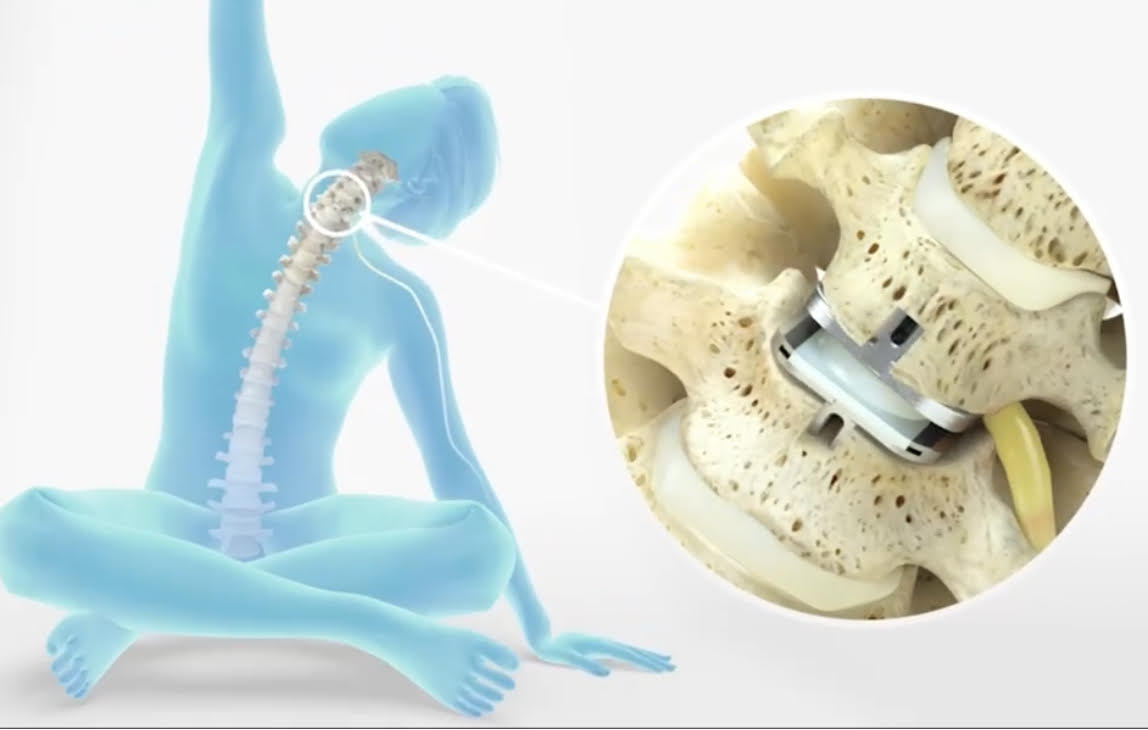
Which Artificial Disc to Use: We use FDA approved options such as Prodisc C, Prodisc Vivo, and Simplify for cervical disc replacement and activL and Prodisc L for lumbar disc replacements. These implants differ in core design, materials, and sizing to match a wide range of anatomies and motion needs. Some are approved for one level and others for two levels in the C3 to C7 region, and certain designs allow excellent MRI visualization. Your surgeon selects the implant based on your natural range of motion, alignment, facet health, and goals, and may use different devices at different levels to achieve the best fit and function.
Why Choosing the Right Artificial Disc Matters
Are you considering disc replacement surgery for your neck or back condition, but are unsure which artificial disc is right for you? There is a lot of information out there to help you in your research which can also be overwhelming. We hear from our patients all the time about how the process of collecting information and doing their research can be stressful and challenging. That’s why it’s crucial to find a spine surgeon that you can trust. Ultimately if you find the right spine surgeon, they will be equipped to guide you through this selection process and provide you with recommendations based on your specific anatomy and degree of your condition.
Our Experience in Disc Replacement Since 2005
Our team at VSI began performing disc replacement surgery in 2005 and is at the forefront of minimally-invasive disc replacement surgery. We are a worldwide destination for disc replacement surgery with our advanced technology and concierge approach. This allows patients to fly in to receive coordinated care and safely get back to what they love – even walking the same day after surgery. In fact, this team has made world news and performed the first multi-level disc replacement surgeries in the world, paving the way for safe and effective recovery for our patients.
At this point, you know the many benefits of disc replacement surgery and now you are doing your research to determine which disc implant is right for you. I can help!
How is disc replacement surgery customized to give each patient the appropriate amount of motion?
This is not a one size fits all surgery. Here at VSI, every surgery and disc replacement is customized to the patient. Meaning, we ensure that the motion is right for each patient through the use of artificial intelligence, patient scans, and evaluations.
While it’s true that not every patient will be a candidate for ADR, our approach is to consider all surgical options and also understand the patient’s goals for recovery. Each patient has a unique anatomy, range of motion, and goals for recovery. It is my job as a surgeon to earn the trust of my patients, make appropriate treatment recommendations, and also educate them on the “why” behind my treatment plan recommendation.
The creativity in our approach to treatment allows patients to receive the most custom solution for their specific condition. Artificial disc replacements provide the benefits of improving range of motion and flexibility after surgery and potentially decrease the risk for additional issues and surgeries in the future.
How We Personalize Motion With AI and Advanced Imaging
The team at VSI has led the research to support these findings that disc replacement surgery is getting better with even more advanced technology. Technology is rapidly advancing in the world of spine surgery when it comes to ADR, even when it comes to picking the right artificial disc for our patients. Patient x-rays and films tell us a lot about what we need to know regarding a patient’s range of motion, which helps our team decide which disc would be right for them.
By now, you know the goal of disc replacement surgery is to save the motion of the discs in your spine, but how does Artificial Intelligence (AI) help us do this?
With the rise in using artificial intelligence to help us calculate the proper range of motion for each patient, the outcomes are even better than before. Instead of using traditional methods to calculate what a patient’s range of motion SHOULD be, we can very accurately determine through AI what the range of motion actually is. Not only are spine surgeons and our patients deciding what disc to use for an ADR, but ever-changing, advanced technology is providing more accuracy than ever and further increases customization.
Did you know we use several different types of artificial discs in order to customize treatment for our patients? In fact, there are 4 different types for cervical or neck and 2 different kinds for lumbar. That’s because each implant is different, just like our patients’ needs. Every implant isn’t right for every person; think of it as a spectrum in which certain implants move a lot, and some are stiffer – just like with our patients’ ranges of motion.
Just like a new iPhone, each version of a disc replacement gets better & better. Our team has continued to be a part of research with manufacturers to help improve discs for our patients. The use of Artificial Intelligence is helping surgeons get even more precise measurements on patients at their normal range of motion. Basically, AI is taking any guesswork out of the decision-making process, and very accurately getting the right disc replacement for our patients by determining the appropriate disc for them.
Types of Cervical Artificial Discs: Prodisc and Simplify
The anatomy in the neck is smaller and the motion is more predictable, so we have more implant options available. These are a few implants for cervical total disc replacement (C-TDR), with some basic facts, in alphabetical order:
- Prodisc C and Prodisc Vivo– This implant gained FDA approval for replacing 1 level of the disc in the C3-7 region in 2007 and is reported as the most studied implant in the world dating back to 1990. It has 2 metal (cobalt chrome alloy) endplates with a plasma-sprayed titanium surface and plastic (polyethylene) inlay. It has a ball and socket concept with a fixed center of rotation allowing for both motion and stability. There are a variety of implant sizes available.
- Simplify – This implant gained FDA approval for replacing 1 level of the disc in 2020 and 2 levels in 2021 in the C3-7 region of the neck. It is made of 2 plastic (PEEK) endplates coated with a titanium plasma spray and ceramic core material which allows for detailed anatomic visualization on MRI. This 3 pieces semi-constrained proprietary disc design provides unique articulation which allows for a variable center of rotation for each treated level and is designed to closely mimic the motion dynamics of a natural spine segment. There are a variety of implant size options, including 5 degrees of lordosis.
Types of Lumbar Artificial Discs: ActivL and Prodisc L
The spinal anatomy in the low back is larger with differing angles of disc orientation making the motion at each segment trickier to predict. As a result, we have fewer arthroplasty implants available. These are a few implants for lumbar total disc replacement (L-TDR) in alphabetical order:
- ActivL – This implant gained FDA approval for the replacement of 1 level of the disc at either L4/5 or L5/S1 in 2015. It is made of 2 endplates made of mixed metal (cobalt-chromium metal alloy with titanium coating) and a plastic (polyethylene) insert that fits between the 2 endplates There are a variety of implant sizes available.
- Prodisc-L – This implant gained FDA approval for replacing 1 level of the disc in 2006 and 2 levels of the disc in 2020 in the L3-S1 levels of the low back. It is reported as the most studied implant in the world dating back to 1990. It has 2 metal (cobalt chrome alloy) endplates coated with a plasma-sprayed titanium surface and a plastic (polyethylene) inlay. It has a ball and socket concept with a fixed center of rotation allowing for both motion and stability. In addition to a variety of implant sizes, several angled endplates were developed for lordosis.
Next Steps Talk With a Spine Specialist You Trust
At VSI, we get it. You have done a ton of research and have seen all the information out there, and now it’s time to talk to a spine specialist about your findings. The most important part now is picking a qualified spine surgeon that will make sure you find the appropriate disc. The surgeons at VSI are the best in the world and have performed many world’s-first disc replacement procedures. Our team is at the forefront of new technology that can better serve our patients.
Topics covered
About the Author

Featured Resources
Insights to Achieve a Pain-Free Life