
Disc Replacement vs. Fusion: Decision-Making, Prehab and Recovery
Disc Replacement vs. Spinal Fusion: Quick Takeaways
- Disc replacement is designed to preserve motion at a painful spinal level, while spinal fusion is designed to add stability when abnormal motion is part of the problem. One is not automatically better than the other.
- The right spine surgery decision starts with identifying the source of pain, reviewing imaging and medical data, and understanding what the patient wants to return to, whether that is their job as a first responder, playing with their children, returning to their sport, or simply moving through daily life with less pain.
- Prehab before spine surgery can help prepare the body, improve mobility and strength, address nerve tension, reduce pain and inflammation, and create a smoother recovery plan before surgery even happens.
- Physical therapy after spine surgery is more than just a final step. It helps patients regain function, rebuild movement patterns, and progress safely from structure to function to performance.
- VSI’s approach brings the spine surgeon and physical therapy team together before and after surgery so the recovery plan is built around the individual, not just the procedure.
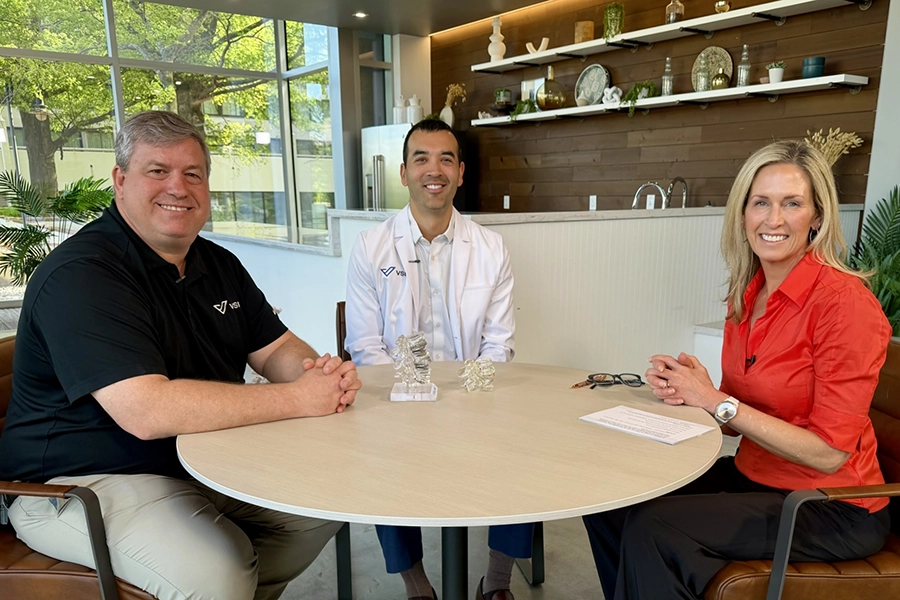
Disc replacement or spinal fusion surgery: It is one of the most common and yet most confusing decisions patients face when spine surgery becomes part of the conversation. In this episode of Get Back to Your Life®, VSI spine surgeon Dr. Colin Haines and physical therapist Larry Grine explain why the “best” surgery is not the same for everyone. The right choice depends on your anatomy, your pain drivers, your movement patterns, your recovery goals, and the long-term plan for helping you get back to the life you love.
Watch the Podcast on Youtube
Why Is Choosing Between Disc Replacement and Fusion So Confusing?
Choosing between disc replacement and fusion is confusing because patients now have more information than ever, but not always the right clarity for their specific condition. Online research, social media groups, second opinions, and other patients’ stories can be helpful, but they can also make the decision feel overwhelming.
As Dr. Haines explains in the episode, “More information is a wonderful thing, but too much information can be the paralyzing.” His point is that patients do not just need more content. They need the right interpretation of that information, guided by their individual anatomy and goals.
Larry Grine sees the same challenge in physical therapy. Patients often compare themselves to a neighbor, friend, or someone in an online support group who had the “same” procedure. But as he explains, two people can have the same surgery and still have very different recoveries because their bodies, starting points, pain drivers, and goals are different. That is why the conversation at VSI is not simply: Should this patient have disc replacement or fusion? The more important question is: What does this specific patient’s body need to move forward safely, successfully, and for the long term?
Is Disc Replacement Better Than Fusion?
Disc replacement is not automatically better than fusion, and fusion is not automatically better than disc replacement. The right procedure is the one that matches the problem.
Artificial disc replacement, also called ADR, is often attractive to patients because it preserves motion. For the right patient, that can be a powerful advantage. But if abnormal motion is the reason for pain, preserving that motion may not solve the problem. In those cases, spinal fusion may be the better option because it stabilizes the painful segment.
Dr. Haines describes the difference this way: if the issue is instability, such as too much movement at one spinal level, fusion may be most successful because it stops the abnormal motion. If the issue is a painful disc without instability, disc replacement may be effective because it replaces the damaged disc while allowing continued motion.
Some patients may even benefit from a hybrid spine surgery approach, where one level needs stability through fusion and another level benefits from motion preservation through disc replacement. This is where customization becomes especially important. The goal is not to force every patient into one category. The goal is to evaluate each spinal level and choose the strategy that makes the most sense.
What Factors Help Determine the Right Spine Surgery?
The decision between disc replacement, fusion, or a hybrid approach depends on the patient’s anatomy, imaging, pain source, movement patterns, age, health, activity goals, and long-term function.
At VSI, the care team looks at objective medical data alongside the patient’s functional goals. That means the decision is based on what appears on an MRI or X-ray as well as what the patient wants to get back to doing.
As Dr. Haines shares, the team spends time identifying not only the medical problem, but also the life goal behind the visit. For one patient, success may mean getting back to golf. For another, it may mean simply playing with their children again. Those goals shape the treatment plan and the recovery plan. Larry explains that clear goals also make recovery more focused:
Expectations are huge, people that actually are a little more tenacious in understanding what they want to achieve and have clear goals and expectations have a clearer path…It’s hard to know where your finish line is if you don’t know your goals and objectives
LArry Grine, Physical therapist
In other words, the finish line matters. When patients and providers know what success looks like, the care plan can be built with that destination in mind.

Get Your Spine Surgery Questions Answered
When Might Fusion Be the Better Option?
Fusion may be the better option when the painful spinal level needs stability. This can happen when abnormal motion, slippage, curvature, or painful facet joints contribute to the patient’s symptoms.
In the episode, Dr. Haines mentions several factors that may point toward fusion, including spondylolisthesis, scoliosis, and significant facet joint pain. These are examples of situations where the body may benefit from stopping painful motion at a specific level.
Fusion does not mean the entire spine is fused. It typically targets the specific level or levels causing the problem. The purpose is to stabilize the area so the body can move better overall, with less pain from that unstable segment.
When Might Disc Replacement Be the Better Option?
Disc replacement may be the better option when the main problem is a painful disc and the spine does not show instability at that level. The goal is to replace the damaged disc while preserving motion.
For many patients, motion preservation is appealing because it supports more natural movement and may reduce stress on neighboring levels. However, disc replacement still needs to be matched carefully to the patient’s anatomy and diagnosis. Dr. Haines makes it clear that although disc replacement can sound like the more exciting option, it is not right for everyone. As he says near the end of the episode, “Motion preservation, disc replacements sound sexy, right? If I had a spinal condition, that’s what I would want. But it’s not perfect for everyone.”
That honesty is central to the VSI approach. Patients deserve a recommendation based on what their body needs, not based on a surgeon’s preference for one procedure.
What Is a Hybrid Spine Surgery?
A hybrid spine surgery combines spinal fusion and artificial disc replacement when different levels of the spine need different solutions. One level may need the stability of fusion, while another level may benefit from the motion-preserving design of disc replacement. This approach reflects a more personalized way of thinking about spine surgery. Instead of treating the spine as if every level has the same problem, the surgeon evaluates each level individually.
Larry describes hybrid procedures as part of the evolution of spine care and notes that they can be a game changer for the right patient. The key is matching the procedure to the patient’s specific structural needs and recovery goals.
Why Does Prehab Matter Before Spine Surgery?
Prehab matters because the best recoveries often begin before surgery. Prehab is physical therapy designed to prepare the body for surgery by improving mobility, strength, nerve movement, pain control, and overall readiness.
Larry defines prehab in the episode as “dedicated physical therapy in preparation of getting them better before they have surgery.” He explains that patients who do prehab tend to have smoother recoveries because they are preparing the body before the procedure.
Prehab may include a comprehensive evaluation, manual therapy, mobility work, strengthening, nerve mobility, education, and recovery planning. At VSI, it can also include advanced recovery-supporting tools such as hyperbaric oxygen therapy, class 4 laser therapy, shockwave therapy, dry needling, and targeted exercise prescription when appropriate. The purpose is not just to “check the box” before surgery. Prehab helps the team understand the patient’s pain drivers, movement limitations, and physical baseline. That information can guide the surgical decision and shape a more specific recovery plan.
As Dr. Haines explains, VSI now focuses on planning therapy before and after surgery, rather than treating surgery as a standalone event. The process becomes more comprehensive: evaluation, preparation, procedure, and guided recovery.
What Does Recovery Look Like After Disc Replacement or Fusion?
Recovery after disc replacement or fusion is highly individualized, but early movement is an important part of modern spine surgery recovery. Dr. Haines explains that patients are walking very soon after surgery, often walking from the stretcher to the bed once they are awake and medically ready.
The initial hospital therapy focuses on safe movement and getting the patient comfortable enough to function at home. After that, more specific physical therapy begins. At VSI, therapy may start sooner than many patients expect, especially for disc replacement patients who may experience nerve tightness as the body adjusts to a restored disc height and renewed motion.
Dr. Haines notes that with disc replacement, the nerve may need to adjust not only to being in a better position, but also to moving again. That can lead to temporary nerve irritation or tightness in some patients, which is one reason early, high-level physical therapy can be so important.
Larry explains that multiple-level procedures often require more detailed care because the body may have a larger inflammatory response and more biomechanical needs to address. His summary is simple: the body is built to move, but movement has to be structured, planned, and progressed safely.
Is Physical Therapy Really Necessary After Spine Surgery?
Yes, physical therapy is a critical part of long-term recovery after spine surgery. Surgery helps address structure, while physical therapy helps restore function, movement quality, strength, and performance.
Larry explains this clearly in the episode: “Structure leads to function. Function leads to performance.” Surgery may improve the structural problem, but many patients still have underlying movement patterns, weakness, stiffness, or nerve mobility issues that need to be addressed after the procedure.
This is especially important because many spine conditions develop over time. Even when surgery significantly reduces pain, the underlying deficits that contributed to the problem may still need rehabilitation. Skipping physical therapy can limit long-term success because the body may not relearn how to move well.
Dr. Haines adds that patient compliance often improves when patients understand why therapy matters. Education helps patients see that surgery may get them most of the way there, but high-level recovery requires a commitment to the full process.
How Do VSI Surgeons and Physical Therapists Work Together?
VSI’s surgeon and physical therapy teams collaborate before and after surgery to align the procedure, recovery plan, and patient goals. This matters because recovery is not treated as an afterthought.
Dr. Haines gives a real example of calling or texting Larry when he wants another perspective on whether a patient’s pain may be coming from the facet joints. He describes the importance of using the full team and “check, check, check and recheck” when making a major decision like fusion versus disc replacement.
Larry explains that VSI’s one-on-one treatment model gives therapists time to assess patients closely, perform movement testing, identify pain drivers, and communicate with the surgical team. That ongoing communication allows the plan to be adjusted when needed, instead of waiting months for the next appointment.
For patients, this means they are not being passed from one disconnected provider to another. They are supported by a coordinated team that understands the surgery, the recovery, and the life goals behind both.
What Should Patients Know Before Deciding on Spine Surgery?
Patients should know that disc replacement versus fusion is not a decision that should be rushed. It requires time, diagnostic review, clinical judgment, and a clear understanding of the patient’s goals.
Dr. Haines says this is not the type of decision that should be made by a doctor with “his hand on the doorknob” before walking out. The nuances matter. The patient’s anatomy matters. The recovery plan matters. The long-term goal matters.
Whether you’re having a disc replacement or fusion, having a plan is the difference between hoping you’ll heal and knowing you will.”
Dr. Colin Haines
Larry’s advice is equally important: patients need to commit to the recovery process. Surgery is a major step, but the recovery plan is what helps patients build toward lasting function. As he explains, the physical therapy team’s role is to walk with the patient step by step and guide them through the process.
The biggest takeaway from this episode is that patients do not need to choose a surgery based on fear, pressure, or someone else’s story. They need a team that understands all options and can help them choose the right path for their body.
Frequently Asked Questions About Disc Replacement vs. Fusion
What is the main difference between disc replacement and fusion?
Disc replacement preserves motion at the treated spinal level, while fusion stabilizes the level by stopping motion there. The right option depends on whether the patient needs motion preservation, stability, or a combination of both.
Is artificial disc replacement always better than spinal fusion?
No. Artificial disc replacement can be an excellent option for the right patient, but it is not right for everyone. If abnormal motion or instability is part of the problem, fusion may be the better surgical choice.
Is spinal fusion always more limiting?
Not necessarily. Fusion targets the specific level that needs stability. For patients whose pain is caused by too much motion at one level, fusion can help restore function by stabilizing that painful area.
What is prehab before spine surgery?
Prehab is physical therapy before surgery that prepares the body for the procedure and recovery. It may focus on mobility, strength, nerve motion, pain control, education, and identifying pain drivers.
Why do patients walk so soon after spine surgery?
At VSI, our patients are up and walking the same-day after their procedure. Early walking helps support mobility, circulation, and recovery. Many patients are encouraged to begin walking shortly after surgery once they are able.
Can two people have the same spine surgery and recover differently?
Yes. Two people can have the same procedure and experience very different recoveries because their anatomy, pain history, strength, mobility, goals, and number of treated levels may all be different.
How do I know which spine surgery is right for me?
The right spine surgery depends on a detailed evaluation of your imaging, diagnosis, pain source, spinal motion, lifestyle, and goals. A surgeon who has experience with both disc replacement and fusion can help determine which option best fits your body.
The Right Spine Surgery Starts With the Right Plan
Disc replacement and fusion are both powerful spine surgery options, but they solve different problems. The right decision is not about choosing the procedure that sounds best. It is about choosing the approach that fits your anatomy, your goals, your recovery needs, and your long-term life.
At VSI, that decision is made through a team-based process that includes surgical expertise, physical therapy insight, prehab, recovery planning, and patient education. Because whether the right path is disc replacement, fusion, or a hybrid approach, successful recovery starts with a plan.
If you have been told you may need spine surgery and feel overwhelmed by conflicting information, a personalized evaluation can help you move from confusion to clarity and take the next step toward getting back to your life.
Topics covered
About the Author

Featured Resources
Insights to Achieve a Pain-Free Life