
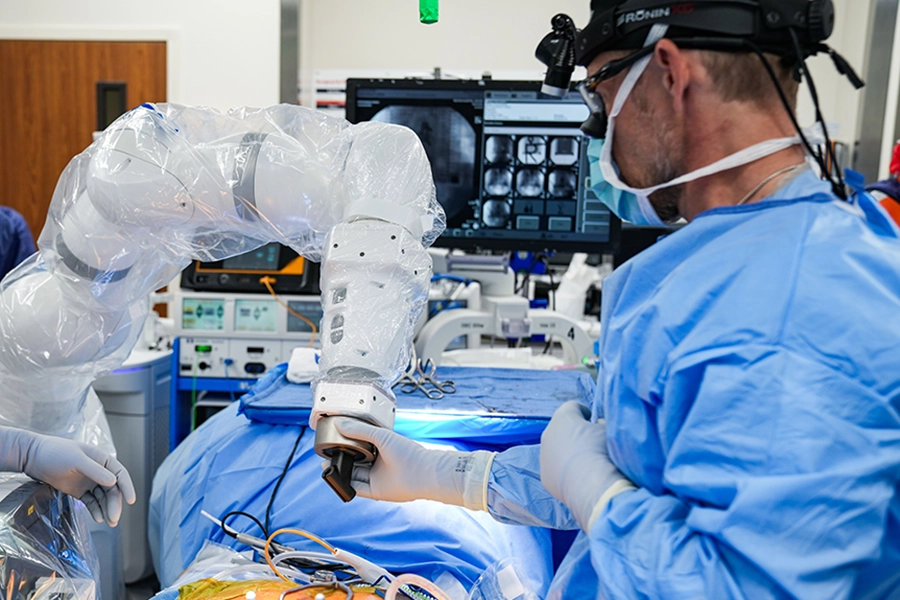
How Robotics, AR, 3D Printing and Endoscopy Are Improving Spine Surgery Results
Key Takeaways:
Modern spine surgery utilizes advanced surgical technology and precise, minimally invasive techniques to improve surgical accuracy and minimize tissue disruption. Key technologies include:
- Robotic-Guided Surgery: Provides sub-millimeter guidance for spinal instrumentation and implant placement.
- Augmented Reality (AR): Projects 3D anatomical data directly into the surgeon’s operative field to visualize the patient’s spinal anatomy during surgery, almost like they have x-ray vision. This ensures the surgery is less-invasive and more precise.
- AI and 3D Printing: Utilizes X-Ray and CT imaging to create customized spinal implants with more accuracy than ever before.
- Endoscopic Surgery: Employs high-definition visualization to treat spinal conditions through tiny, minimally-invasive incisions (approx. 7–8mm).
- Clinical Objective: These tools are used to improve recovery timelines and decrease hospital stay.
The Transition to Precision-Guided Spine Care
The standard of care in spine surgery at VSI avoids conventional open techniques and focuses on a personalized, safer model. This evolution is supported by a technical advancements designed to optimize each phase of the surgical procedure:
| Technology | Surgical Application | Primary Objective |
|---|---|---|
| Robotics | Navigation and trajectory guidance | Accuracy in hardware placement |
| Augmented Reality | Real-time anatomical visualization | Enhanced safety in complex areas |
| 3D Printing | Patient-matched implants/models | Improved fit and structural integration |
| Endoscopy | Targeted decompression | Minimal soft-tissue disruption |
What Technologies Are Changing Spine Surgery?
Modern spine surgery is not defined by one tool or one technique. It is shaped by a combination of technologies that help surgeons plan better, customize treatment, and operate with greater precision. This ultimately results in safer surgeries with shorter recovery times for patients.
Robotics, augmented reality, 3D printing for spine, and endoscopic spine surgery each play a unique role in improving the surgical experience. Together, they are helping move spine care toward a more personalized, precision-guided model.
| Technology | What It Helps With | Patient Benefit |
|---|---|---|
| Robotics | Surgical planning, navigation, and implant placement | Greater precision, consistency, and confidence during complex procedures |
| Augmented Reality | Real-time 3D visualization of spinal anatomy | Improved guidance and visibility during surgery |
| 3D Printing | Patient-specific implants, models, and planning tools | A more personalized fit and better preparation for complex anatomy |
| Endoscopy | Small-camera visualization through smaller openings | Less tissue disruption in selected cases |
These technologies often support different types of procedures. For example, robotic spine surgery may be used to help plan and guide implant placement. Augmented reality spine surgery can help surgeons visualize anatomy in a more detailed way during the procedure. 3D printed spinal implants and models can make treatment more customized to a patient’s unique anatomy. Endoscopic spine surgery can help reduce disruption to muscles and soft tissue for certain conditions.
The goal is not to use every technology for every patient. VSI’s goal is to choose the right technology for the right condition, anatomy, and treatment plan.
For some patients, that may mean a minimally invasive endoscopic procedure. For others, it may mean robotic guidance during spinal fusion, augmented reality support during a complex surgery, or a custom 3D printed implant designed around their anatomy. In many cases, the most advanced approach is not the most complicated one. It is the one that gives the patient the safest, most effective, and most personalized path forward.
Robotic Assistance in Spinal Navigation
Robotic systems function as advanced navigational aids with real-time tracking and guidance. The surgeon remains the primary operator, using the robotic arm as a guide to execute a pre-planned surgical trajectory.
- Pre-operative Planning: Utilizing CT-based mapping, surgeons can simulate screw placement and alignment before the first incision.
- Mitigating Human Variance: Robotics provides a high degree of repeatability, particularly valuable in complex fusions or cases with distorted anatomy.
- Minimally Invasive Access: Precise guidance allows for percutaneous (through the skin) hardware placement, reducing the need for extensive muscle stripping.
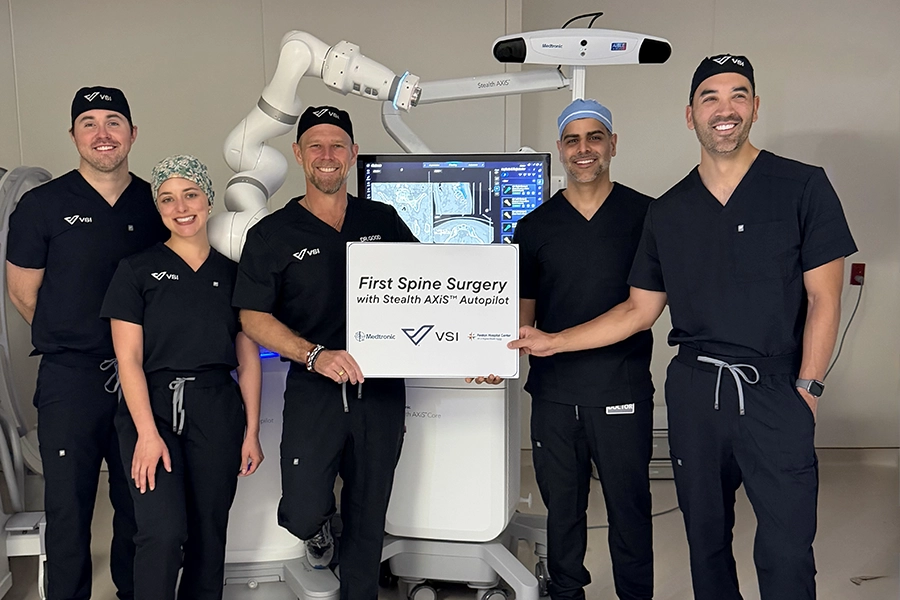
VSI has been on the leading edge of robotic-guided innovation in surgery, working with Medtronic in the evolution of multiple robots since 2012. In April 2026, our team performed the world’s first spine surgery with the Stealth AXiS™ Autopilot Robotic System, which is the latest innovation in safer, more precise spine surgery. This next-generation platform integrates AI-powered surgical planning, robotic guidance, optical navigation, and real-time segmental tracking into a single, connected workflow.
Augmented Reality (AR) Spine Surgery Helps Surgeons See More Clearly
Augmented Reality imposes diagnostic imaging data—such as 3D CT reconstructions—directly into the surgeon’s line of sight via specialized headsets, like they have ‘x-ray’ vision of the spine while they are operating.
- Continuous Visualization: Surgeons can view the underlying spinal anatiomy without looking away from the operative site to a secondary monitor.
- Anatomical Accuracy: Real-time overlays assist in identifying critical structures, including neural elements and vascular pathways, during decompression.
- Procedural Efficiency: Improved orientation can reduce the time required for hardware orientation and localization.
VSI has lead and published research which shows the safety and accuracy of utilizing Augmented Reality technology in spine surgery. Read more about VSI’s research on utilizing AR for placing screws in surgery.
3D Printing and Patient-Specific Implants
The application of 3D printing in spine surgery allows for the fabrication of implants and models tailored to the patient’s unique anatomy.
- Customized Surfaces: 3D-printed titanium cages feature porous, lattice-like structures that mimic cancellous bone, promoting osteointegration (the direct functional and structural connection between living bone and the implant).
- Management of Complex Deformities: For patients with significant scoliosis or structural bone loss, custom implants offer a superior fit compared to standard “off-the-shelf” components.
- Surgical Modeling: Physical 1:1 scale models of a patient’s spine allow for pre-operative planning of complex corrective procedures.
Endoscopic Spine Surgery Can Reduce Tissue Disruption
Endoscopic spine surgery techniques involve the use of a micro-camera (endoscope) and specialized instruments to treat spinal conditions through a tiny incision.
- Targeted Decompression: High-definition visualization allows for the removal of herniated disc fragments or bone spurs while preserving the stability of the surrounding facet joints and ligaments.
- Muscle Preservation: The endoscopic approach utilizes serial dilation to move muscle fibers aside rather than cutting them, significantly reducing postoperative pain and the risk of atrophy.
- Anesthesia Options: Selected endoscopic procedures may be performed under conscious sedation or local anesthesia, which may be preferable for patients with comorbidities that increase the risks of general anesthesia.

Ready to Take the Next Step?
How Technologies Integrate for Improved Results
Advanced technology is most effective when used as an integrated system rather than in isolation. This cohesive integration allows for a comprehensive, multi-phase approach to surgery. For more explanation, watch Dr. Good explain the role that robotics and technology play in spine surgery:
1. Pre-Operative Phase: Strategic Planning
- Advanced Imaging & 3D Planning: Surgeons utilize high-resolution data to map unique anatomy and identify potential surgical challenges.
- 3D Modeling: In complex cases involving significant degeneration or prior surgeries, physical models allow the team to rehearse corrective maneuvers.
- Custom Implants: If standard hardware is insufficient, 3D-printed implants are designed to match the patient’s specific spinal alignment.
2. Intra-Operative Phase: Execution & Navigation
- Robotic Guidance: Ensures that the pre-operative plan is executed with sub-millimeter consistency during hardware placement.
- Augmented Reality: Provides real-time 3D anatomical overlays, maintaining surgical orientation without the need for large-scale exposure.
- Endoscopic Access: For targeted pathology, the endoscope allows for definitive treatment through minimal corridors, preserving healthy soft tissue.
Clinical Benefits: What “Better Results” Mean for the Patient
“Improved results” are defined by clinical outcomes that prioritize safety and recovery speed. Depending on the specific procedure, benefits may include:
- Reduced Bodily Stress: Smaller incisions and less muscle trauma lead to decreased blood loss and lower infection risks.
- Early Movement: Faster recovery of mobility helps prevent complications associated with prolonged bed rest.
- Reduced Hospital Stay: Many advanced procedures allow for shorter stays or transition to outpatient (same-day) surgery.
- Long-Term Success: Precision-guided implant placement and custom hardware optimize the structural integrity of the spinal repair.
Utilizing surgical technology in surgery is part of VSI’s broader commitment to making recovery a central part of the spine care experience, not an afterthought. By combining surgical expertise, personalized planning, and integrated post-procedure therapies under one roof, VSI uses technology to perform surgery better and to help patients heal with more confidence and get back to their lives.
Safety and Suitability in Spine Surgery
Does Technology Make Surgery Safer?
The use of technology, as well as advanced surgical techniques, mitigates variables and greatly improves safety:
- Enhanced Visualization: Reducing the risk of injury to adjacent structures.
- Consistent Accuracy: Robotic guidance minimizes the human variance in hardware trajectory.
- Careful Selection: Technology is a tool, not a requirement. Safety is highest when the tech is matched specifically to the patient’s diagnosis and anatomy.
Is Advanced Technology Right for Every Patient?
Innovative tools are used selectively based on what would improve the surgical outcome.
- Non-Surgical Treatment: Conservative care (spine-specialized physical therapy, injections) is often exhausted before surgery is considered.
- Case-Specific Matching: A simple disc herniation may be improved using an endoscope, while complex scoliosis may require the full integration of robotics and 3D printing.
- Individualized Diagnostics: The final recommendation is always based on symptoms, medical history, and imaging—not the availability of a specific device.
The Role of Clinical Judgment
Technology enhances, but does not replace, surgical expertise. The most successful outcomes are the result of:
- Specialized Training: Mastery of robotic and endoscopic platforms.
- Case Selection: Knowing when technology adds value and when a traditional approach is safer.
- Real-Time Adaptation: The ability of the surgeon to adjust the plan based on intra-operative findings that a digital system may not fully capture.
The Future of Spine Care
The trajectory of spine surgery is moving toward a precision-guided and patient-centered future. The goal of innovation at VSI is to utilize these tools to solve complex spinal problems with the highest level of accuracy and the lowest possible disruption to the patient’s life.
Frequently Asked Questions on Spine Surgery Technology
Is robotic spine surgery performed by a robot or a surgeon?
The procedure is performed entirely by the surgeon. The robotic system acts as a high-precision navigational guide, ensuring that the surgeon’s instruments and implants follow a pre-mapped, sub-millimeter trajectory. The surgeon maintains full control and can adjust the plan at any moment based on clinical judgment.
What is the primary difference between endoscopic and minimally invasive surgery?
While both aim to reduce tissue trauma, endoscopic spine surgery is considered “ultra-minimally invasive.” It utilizes a tiny camera (endoscope) through a portal roughly the size of a fingernail (7–8mm). This often allows for the procedure to be performed without cutting any muscle fibers and, in some cases, under local anesthesia.
Are 3D-printed spinal implants safe for long-term use?
Yes. These implants are typically made from medical-grade titanium or specialized polymers. 3D printing allows for a porous surface that mimics natural bone structure, which can actually improve long-term stability by encouraging the patient’s own bone to grow into the implant (osteointegration).
Does the use of advanced technology increase recovery time?
On the contrary, the primary goal of using robotics, AR, and endoscopy is to decrease recovery time. By increasing surgical precision and minimizing the size of incisions, patients generally experience less postoperative pain, reduced blood loss, and a faster return to daily activities compared to traditional open surgery.
Is every patient a candidate for these technologies?
No. Technology is a tool used to solve specific problems. While many patients benefit from robotic or endoscopic approaches, some complex spinal conditions may still require traditional or hybrid surgical techniques to ensure a safe and effective correction.
How do I know which technology is right for my condition?
The choice of technology is determined during a comprehensive evaluation. Your surgeon will review your imaging (MRI/CT), physical symptoms, and goals for treatment to determine if a precision-guided approach like robotics or an ultra-minimally invasive endoscopic procedure offers the best probability for a successful outcome.
Topics covered
About the Author

Featured Resources
Insights to Achieve a Pain-Free Life