
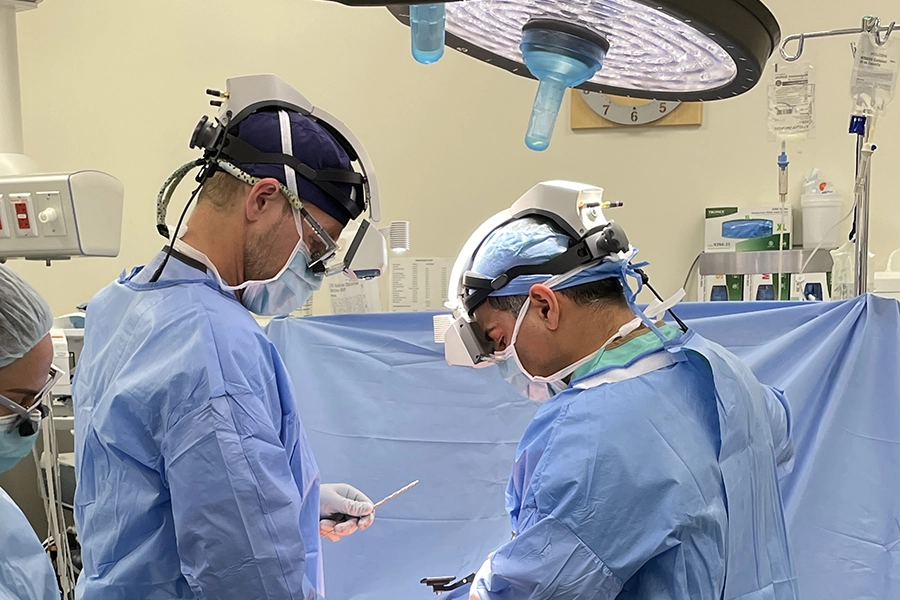
What Role Does Augmented Reality Play in Modern Spine Surgery?
Key Facts
- Augmented reality (AR) overlays a 3D map of your own spine, built from your imaging, directly onto the surgeon’s view of the surgical field during an operation.
- Its main purpose is precision: helping the surgeon place instrumentation like pedicle screws accurately while avoiding the nerves and vessels packed tightly around the spine.
- Published clinical studies report AR-assisted pedicle screw placement accuracy in the range of roughly 94 to 100 percent, as well as reduced radiation exposure for the patient from fewer intraoperative X-rays.
- AR is not the same as robotic surgery. AR enhances what the surgeon sees; robotics enhances the precision of movement. The two often work together during surgical procedures.
- AR is a tool that supports the surgeon’s skill and judgment. It does not replace surgical training or experience, and it is not needed for every procedure.
Spine surgery has traditionally demanded an exact combination: the precision of millimeters in an area crowded with nerves and blood vessels, performed on a structure that is both deep inside the body and constantly in motion.
For decades, surgeons have relied on imaging like X-ray and CT to navigate that terrain. Augmented reality is the newest tool in real-time surgical imaging, and it is changing what a surgeon can see while operating.
This article will explain what AR actually does in the operating room, where the evidence supports it, and just as importantly, how it cannot replace the skill of a trained surgeon.
What Is Augmented Reality in Spine Surgery?
Augmented reality superimposes computer-generated images onto the real world. In spine surgery, the digital layer is a precise 3D model of your spine, built from your own CT or MRI imaging, projected into the surgeon’s field of view, usually through a head-mounted display worn like a visor.
This is different from virtual reality. Virtual reality replaces your view of the world with a fully digital environment. Augmented reality keeps the real surgical field in view and adds information on top of it. The surgeon still sees the actual patient, incision, and instruments, with the digital anatomy placed precisely over them.
How Does AR Actually Work During an Operation?
The process has three stages, outlined below.
1. Building the Map
Before surgery, your imaging is used to construct a detailed 3D model of your spine. This is your specific anatomy, not a generic template: the exact shape of your vertebrae, the position of the structures around them, and the planned trajectory for any hardware that will be placed.
2. Registering the Map to You
In the operating room, that 3D model has to be aligned precisely with your actual body on the table. This step, called registration, is what makes the digital overlay trustworthy. Once registered, the model tracks to your anatomy so that what the surgeon sees in the headset corresponds to where things actually are.
3. Operating With the Overlay
During the procedure, the surgeon sees the critical anatomy and the planned instrument trajectories overlaid on the surgical field. For a step like placing a pedicle screw, which has to follow a precise path through a narrow corridor of bone with nerves on either side, the overlay shows the intended angle and depth in real time.
The spine requires more precision than other areas of the body. This is because the pedicle, the bony channel that screws pass through, sits millimeters from the spinal cord and nerve roots. A screw placed a few degrees off can cause nerve injury or require a return to the operating room.
Traditional navigation works, but it often relies on repeated X-rays and on the surgeon shifting attention away from the field to look at a separate screen. AR keeps the guidance in the surgeon’s line of sight, making the surgery safer for the patient.

Learn more about spine surgery technology
Why AR Matters for Spine Surgery: The Evidence
This is where it is important to separate promise from proof. The clinical evidence for AR in spine surgery is genuinely encouraging, particularly for the accuracy of pedicle screw placement.
VSI pioneered a study in 2022 on the accuracy and safety of placing 218 screws in Augmented Reality-Assisted Spine Surgery. Drs. Christopher Good, Colin Haines, and Ehsan Jazini were co-authors on the study, which was published in the National Institute of Health in 2022. This study reports a stunning overall accuracy of 97.1% across 218 AR-guided screws with no intra or early postoperative complications.
A 2021 study in the Journal of Neurosurgery: Spine reported on the first 205 pedicle screws placed with AR assistance using a head-mounted display, and found an overall placement accuracy of 98 percent as graded by an independent, blinded neuroradiologist.
A 2025 randomized, multicenter controlled trial of 150 patients, published in Orthopaedic Surgery, compared AR-guided screw placement to conventional freehand technique. The AR group achieved a significantly higher rate of excellent and good screw placement, with success rates around 98-99% vs. roughly 92% for the conventional group.
A 2025 narrative review pooling experience across multiple AR platforms found pedicle screw placement accuracy rates ranging from 93 to 100 percent, frequently with reduced fluoroscopy time and improved surgeon ergonomics.
Three benefits show up consistently across this literature:
Accuracy: AR-assisted instrumentation placement is highly accurate, which matters most in exactly the high-stakes locations where error is costly. According to the study pioneered by VSI, placing screws with augmented reality resulted in a 97.1% accuracy.
Reduced radiation: Because AR navigation can reduce the need for repeated intraoperative X-rays (fluoroscopy), it can lower radiation exposure for both the patient and the surgical team.
Better workflow in minimally invasive surgery: In minimally invasive procedures, the surgeon works through small openings and cannot see the full field directly. AR provides the spatial understanding that a direct line of sight would otherwise give.
AR, Robotics, and Minimally Invasive Surgery: How They Fit Together
Patients often ask whether augmented reality and robotic surgery are the same thing. They are not, and understanding the difference helps add clarity to the whole picture.
Augmented reality enhances what the surgeon sees. Robotic guidance enhances the precision of movement, helping direct an instrument along a planned trajectory. Minimally invasive spine surgery is the broader goal these tools serve: accomplishing the operation through the smallest possible disruption to muscle and tissue, which supports a smoother recovery.
These are complementary, not competing. A modern procedure might use AR for visualization, robotic or navigated guidance for precision, and a minimally invasive approach to reduce tissue damage, all in service of the same operation.
At VSI, these technologies are part of a broader commitment to advanced surgical spine technology, chosen and combined based on what a given patient’s procedure actually calls for.
See this blog for more on how these surgical technologies are enhancing spine surgery and improving results.
VSI’s Role in Advancing AR Spine Surgery
VSI has not just adopted these technologies; we have helped pioneer them. Our team performed the very first augmented reality spine surgery in the Virginia and DC region in October 2020, led by Dr. Good. Dr. Jazini was among the first in the world to place his 100th pedicle screw using Augmented Reality in spinal fusion surgery. Our team also performed the world’s first augmented reality-guided Bertolotti resection surgery in January 2026, a procedure that removes an abnormal bony structure causing lower back pain. Applying AR navigation to this specific operation was a first, and it reflects how we think about technology: a way to perform difficult procedures with greater precision.
This builds on a broader record of surgical innovation. However, experience, judgment, and patient selection matter more than any technology. But being among the first to apply a tool to a real procedure means understanding its capabilities and its limits more deeply than reading about it allows, and that understanding is what ultimately serves patients.
What AR in Surgery Can and Cannot Do
AR is an assistive tool. It supports the surgeon’s vision and planning; it does not make surgical decisions, and it does not substitute for the years of training and the judgment that determine whether to operate, how to operate, and when not to. A less experienced surgeon with AR is not equivalent to an experienced surgeon. Technology amplifies skill; it does not replace it.
It is also not universal. Many spine procedures do not require AR at all, and adding technology for its own sake is unnecessary. The right question is never whether a practice has the most advanced equipment. It is whether the surgeon chooses the right approach for your specific problem.
What This Means for You as a Patient
If you are facing spine surgery, here is the practical takeaway: augmented reality is one of several advances, alongside robotics and minimally invasive techniques, that are collectively making spine surgery more precise and less disruptive than it was even a decade ago. For procedures that involve placing instrumentation near the spinal cord and nerves, AR can meaningfully improve accuracy and reduce radiation exposure.
When you meet with a spine surgeon, it is reasonable to ask what technologies they use and why, and how those choices apply to your specific procedure. A good answer will connect the technology to your anatomy and your goals, not just list impressive equipment. The technology should always be in service of the surgeon’s skill and your outcome, never the other way around.
Frequently Asked Questions
What is augmented reality spine surgery?
Augmented reality spine surgery uses a mounted headset to overlay a 3D model of your spine, built from your own imaging, onto the surgeon’s view of the surgical field. This gives the surgeon real-time guidance on the position of critical structures and the planned path for any instrumentation, improving precision during the operation.
How is AR different from robotic spine surgery?
They solve different problems. Augmented reality enhances what the surgeon sees by overlaying digital anatomy onto the surgical field. Robotic surgery enhances the precision of movement by helping guide instruments along a planned path. They are complementary technologies and are increasingly used together in the same procedure.
Is AR-guided spine surgery safe?
Published clinical studies report high accuracy for AR-assisted instrumentation placement, often in the range of 94 to 100 percent for pedicle screws, along with reduced radiation exposure. As with any surgical technology, safety depends most on the surgeon’s experience and judgment. AR is a tool that supports a skilled surgeon; it does not replace surgical expertise.
Does augmented reality make spine surgery less invasive?
It can support less invasive surgery. In minimally invasive procedures, the surgeon operates through small openings without a full direct view of the field. AR provides the spatial understanding that a larger incision would otherwise offer, which can help enable a minimally invasive approach for appropriate cases.
Is AR used for every spine surgery?
No. Many spine procedures do not require augmented reality. It is most valuable for operations that involve placing hardware near the spinal cord and nerves, where its precision matters most. The right approach depends on your specific condition, and adding technology that a procedure does not need is not a good practice.
Does VSI use augmented reality in spine surgery?
Yes. VSI uses augmented reality among a range of advanced surgical technologies, and our team performed the first augmented reality spine surgery in the Virginia/DC region and the world’s first AR-guided Bertolotti resection. You can learn more about our approach on our surgical spine technology page.
Topics covered
About the Author

Featured Resources
Insights to Achieve a Pain-Free Life