
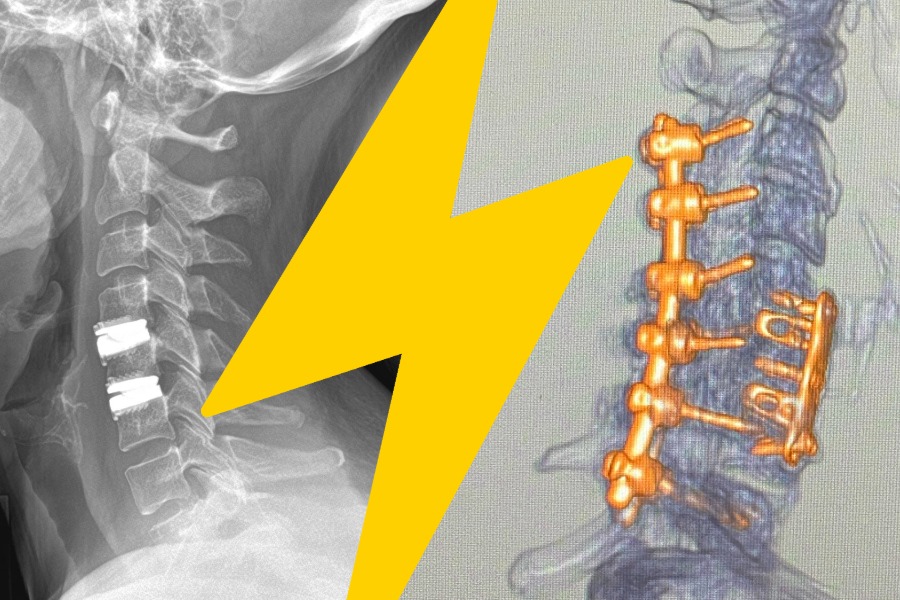
Disc Replacement or Spinal Fusion: Which Surgery Is Right for Me?
Key Takeaways: Disc Replacement vs. Fusion Surgery
- Disc replacement removes the damaged disc and replaces it with an artificial implant that mimics natural movement.
- Spinal fusion permanently joins two vertebrae together, eliminating motion at the affected level.
- Both surgeries relieve spine pain but use different approaches.
- Disc replacement preserves flexibility; fusion provides stability.
What Is the Difference Between Disc Replacement and Fusion Surgery?
Both artificial disc replacement (ADR) and spinal fusion are proven surgical solutions for spine pain, but they differ in approach. Artificial disc replacement replaces a damaged disc with an artificial one to preserve natural motion, whereas spinal fusion permanently joins two vertebrae to stabilize the spine, eliminating motion at that segment. In other words, artificial disc replacement relieves pain while maintaining flexibility in the spine, and fusion relieves pain by stopping movement at the problem level.
What Is Artificial Disc Replacement and How Does it Work?
In this Q&A, a VSI surgeon Dr. Haines explains that artificial disc replacement involves removing the diseased disc and inserting an artificial disc implant that closely imitates a natural disc’s structure and movement. The artificial disc functions as a cushion between the vertebrae, preserving the spine’s normal range of motion while eliminating the source of pain. Artificial disc replacement is a minimally invasive spine surgery where the surgeon removes the degenerated disc and replaces it with an artificial disc, which serves as a shock absorber and maintains natural motion of the spine.
What Conditions Does Artificial Disc Replacement Commonly Treat?
Artificial disc replacement is most commonly used to treat degenerative disc disease, herniated discs, certain cases of spinal stenosis or radiculopathy, and issues at one level of the spine. Typical candidates have disc problems causing nerve compression (e.g. arm pain from a cervical herniated disc, or lower back and leg pain from a lumbar disc) that have not improved with conservative care. Artificial disc replacement can also be an option for patients with a previously failed fusion at an adjacent level or multi-level disc disease, in order to avoid further fusions.
What Is Spinal Fusion?
Spinal fusion is a procedure that eliminates the motion between vertebrae by ‘welding’ the bones together using bone graft and often screws and plates. Essentially, the surgeon removes the damaged disc, relieves nerve pressure by removing bone spurs or doing a laminectomy, and then inserts a bone graft or spacer. Metal screws and rods are typically placed to hold the vertebrae in position while the bone graft heals, eventually fusing the vertebrae into one solid bone unit. This permanent fusion stabilizes that segment of the spine and prevents any painful movement at the affected level.
What Conditions are Treated with Fusion Surgery?
Spinal fusion is often recommended for conditions where stability is a concern or multiple levels are affected. For example, spinal instability (from spondylolisthesis or trauma), degenerative disc disease affecting multiple levels, spinal deformities like scoliosis or kyphosis, fractures, and spine tumors or infections are often treated with fusion. In these cases, fusing the vertebrae can restore proper alignment and stabilize the spine.
What is Hybrid Combination Spine Surgery?
At times, our surgeons combinine both techniques through hybrid spine surgery by fusing the most unstable level and replacing adjacent discs. VSI patients have experienced significant success through the combination of these treatment options and reclaimed their active, full lives. Fusion provides stability where necessary, while the disc replacement maintains the body’s natural movement patterns.
Disc Replacement vs. Spinal Fusion: Side-by-Side Comparison
|
Topic |
Artificial Disc Replacement |
Spinal Fusion |
|---|---|---|
|
What it is |
Removes the damaged disc and replaces it with an artificial disc designed to mimic natural disc movement and preserve motion |
Welds two vertebrae together with bone graft and instrumentation, which can reduce motion at that segment and provide stability |
|
The goal |
Pain relief without sacrificing motion and restoring natural movement at the treated level |
Stabilization without painful motion and correcting spinal alignment |
|
Candidate focus |
Best suited when motion can be preserved safely and spine levels are stable |
Often recommended when stabilization is required such as abnormal motion, instability, or posture and alignment problems |
|
Recovery time and return to activity |
Many patients return to a desk job in about two to four weeks and are commonly cleared for full activity around three months depending on follow up evaluation |
Fusion recovery expectations are initial recovery often four to six weeks, significant healing often three to four months, and full recovery often six to twelve months |
|
Long term considerations |
Long term issues are more often related to instability of the spinal structures and not breakdown of the disc itself |
A major consideration can be breakdown at other levels over time as stress shifts in the spine |

Take the First Step to Relief
What is the Success Rate of Disc Replacement and Fusion Surgery?
VSI surgeons have noted high success in their disc replacement patients. Dr. Haines states “success rate is over 95 percent” for cervical disc replacement in appropriately chosen candidates. Spinal fusion success rates are also high. The biggest takeaway is that both surgeries have high success rates for improving quality of life. Each surgery has their advantages in patient satisfaction and functional scores, and each has their place for restoring our patient’s lives.
What is the Recovery Timeline of Disc Replacement Surgery?
Because no bone needs to fuse in artificial disc replacement, the initial healing is generally quicker. Patients undergoing cervical or lumbar disc replacement often go home the same day or after one night, resume light daily activities within a few days, and usually return to desk work or moderate activity within a few weeks. There is typically less post-op bracing required and patients often experience less stiffness.
What is the Recovery Like for Spinal Fusion?
Fusion involves a bone-healing process that takes time (bone graft integration can take 3-6 months or more). As a result, fusion patients have more activity restrictions in the first few months. A typical hospital stay is 1–3 days, depending on the extent of surgery. Initial recovery includes a few weeks of limited activity where patients must avoid heavy lifting, bending, or twisting. Full return to strenuous activity or sports can take 3–6 months. Patients typically return to desk jobs at 4-6 weeks post-op if one-level, and manual labor jobs may require 3+ months before clearance. Dr. Good has pointed out that with modern techniques and comprehensive recovery at VSI, even fusion patients can recover faster than in decades past.
Who is a Good Candidate for Artificial Disc Replacement?
Patients with single-level or two-level disc disease without significant instability or facet joint arthritis are often good candidates for disc replacement surgery. If neck pain is coming primarily from a bad disc, and the patient has a well-aligned spine, cervical disc replacement can be an excellent option. Similarly, for the low back, those with a herniated or degenerated disc at one level are evaluated for artificial disc replacement.
Who is a Good Candidate for Spinal Fusion Surgery?
Patients with more complex or degenerated disc issues often require a fusion. These could include:
- Multi-level disc disease: If three or more levels are degenerated and causing symptoms, artificial disc replacement is usually not approved for so many levels – fusion (or a hybrid of multiple fusions/disc replacement may be indicated.
- Severe facet joint arthritis: Disc replacement surgery doesn’t address facet pain and preserves motion (which would continue to aggravate arthritic facets), so patients with facet-mediated back or neck pain do better with fusion, which stops the motion at those painful joints
- Spinal instability or spondylolisthesis: If a vertebra is slipping (e.g., due to a pars fracture or severe disc collapse), fusion is often required to stabilize it.
- Spinal deformity: Cases of scoliosis or kyphosis often necessitate fusion to correct alignment. Artificial disc replacement cannot correct significant curvature or tilt of the spine, whereas fusion instrumentation can realign the spine.
- Prior surgery: Patients who have had a laminectomy that removed too much stabilizing bone, or surgeries where spine levels now require stability
Risks, Complications and How We Reduce Them
The risks and complications associated with artificial disc replacement and fusion surgery are similar to the risks associated with any spine surgery. VSI works to reduce those risks through a structured “prehab” leading up to your surgery and a personalized recovery plan.
Disc Replacement Concerns
A key artificial disc replacement concern is the possibility of future pain driven by instability, especially if the spine segment below isn’t an ideal motion-preservation candidate. We do not see the artificial discs themselves “breaking down,” and when problems occur, they are more often related to the functions of the spine segment, not the device itself.
Fusion Surgery Risks
One of the major longer-term considerations with fusion is the potential for breakdown at other levels over time, as the spine redistributes motion and stress to segments above and below the fused area. VSI surgeons work diligently to test the adjacent levels to predict these long-term implications and determine if hybrid spine surgery (fusion surgery and disc replacement) is necessary protect the spine from future breakdown.
How VSI Minimizes Surgical Risk
VSI has several strategies and technologies to reduce surgical risks and complications:
- Advanced Technology (Robotics, Navigation, AR): VSI is a national leader in adopting cutting-edge surgical technology. Dr. Christopher and his team have pioneered the use of robotics and augmented reality (AR) guidance in spine surgery, which increases accuracy and safety. In a press release, VSI noted that AR allows for “precise navigation, minimizes tissue dissection, and increases accuracy, potentially leading to fewer complications, reduced blood loss, and faster recovery.” Robotics and computer navigation similarly ensure optimal implant positioning in disc replacement or fusion, which lowers the risk of things like implant migration.
- Surgeon Expertise and Planning: All cases at VSI are evaluated by experienced spine surgeons, and for complex scenarios, they utilize a team approach (spine surgeons, neurologists, rehab specialists). This review process helps in choosing the right treatment for each patient, thereby avoiding unnecessary procedures and matching patients to the procedure with the least risk for them.
- Enhanced Recovery Protocols (Recovery Revolution™): VSI has implemented a comprehensive recovery movement to speed healing and prevent complications. This includes prehab (so patients are in the best shape going into surgery) and integration of physical therapy, nutrition, and even recovery therapies soon after surgery. All of these measures collectively reduce complication rates and improve outcomes.
Talk With a VSI Spine Specialist
If you’re weighing artificial disc replacement vs. fusion, the next step is an evaluation focused on: your imaging, segment stability, and your goals for surgery. Above all else, we want to ensure the right treatment for your personal needs and ensure you are a partner in your health decisions and getting back to the life you deserve.
Topics covered
About the Author

Featured Resources
Insights to Achieve a Pain-Free Life