
The Technology Behind Motion-Preserving Spine Surgery
Key Facts: Motion-Preserving Spine Technology
- Motion-preserving spine surgery treats damaged spinal levels while maintaining the spine’s natural ability to bend, rotate, and absorb load – unlike spinal fusion, which permanently locks vertebrae in place.
- The main technologies include artificial disc replacement (ADR), the TOPS™ (Total Posterior Spine) System, dynamic posterior stabilization, and hybrid spine surgery, which is a surgery that combines disc replacement surgery with spinal fusion.
- The primary advantage of motion preservation over spinal fusion is preserved range of motion and a reduced risk of adjacent segment disease, which is the degeneration at neighboring spinal levels caused by increased mechanical stress after fusion.
- Artificial disc replacement (ADR) devices are FDA-approved; the TOPS System received FDA Premarket Approval in June 2023 with a rare “superior to fusion” clinical designation.
- Recovery from motion-preserving surgery is faster than traditional spinal fusion, with many patients returning to light activity within a few weeks of surgery.
For decades, spinal fusion surgery was the default answer when conservative treatment stopped working. Fuse the damaged vertebrae, eliminate motion at that level, and eliminate the pain. For many patients, it worked, but it also meant permanently sacrificing movement in part of the spine, and for some, that trade-off created new problems down the road.
Today, a new generation of implant technology is changing that equation. Motion-preserving spine surgery treats the pain while keeping the spine moving the way it was designed to. For patients who are active, younger, or simply want more from their recovery, understanding this technology is a critical part of making an informed decision on spine care.
Why Is Maintaining Spinal Motion Important For My Long-Term Health?
Motion preservation in spine surgery refers to techniques and implants that treat a damaged spinal level while maintaining its natural ability to bend, rotate, and absorb load, rather than locking it permanently in place.
The spine is a dynamic, multi-jointed system. Each level contributes to overall range of motion, and when one level is fused, the levels above and below take on additional stress to compensate. Over time, this accelerated wear can lead to adjacent segment disease (ASD), which is the degeneration at neighboring levels that may eventually require additional spine surgery.
Motion-preserving technology was developed specifically to break this cycle. By treating the damaged level without stopping its movement, surgeons can reduce mechanical burden on surrounding segments and better protect long-term spinal health.
The Core Technologies in Motion-Preserving Spine Surgery
Motion-preserving surgery is not a single procedure – it’s a category of approaches and devices, each designed for specific conditions, spinal levels, and patient profiles.
What Is Artificial Disc Replacement (ADR)?
Artificial disc replacement (ADR) is a surgical procedure in which a damaged or degenerated spinal disc is removed and replaced with a prosthetic implant designed to replicate the disc’s natural height, cushioning, and range of motion.
The implant – typically made of metal and high-grade polyethylene – allows the spine to continue bending and rotating at the treated level, unlike fusion, which permanently locks two vertebrae together. ADR is performed in both the cervical spine (neck) and the lumbar spine (lower back), and is most appropriate for patients with degenerative disc disease or disc herniation at one or two levels with no significant instability or arthritis at the affected joint.
At VSI, ADR has been a cornerstone of patient care for many years. Dr. Christopher Good – leader of VSI and double board-certified in both spine surgery and orthopedic surgery – performed the first three-level cervical disc replacement in the Mid-Atlantic region and the first M6-C disc replacement in the Washington, D.C. metro area. Dr. Ehsan Jazini and Dr. Colin Haines are recognized among the top disc replacement surgeons in the United States and performed the first ADR case in the country using augmented reality surgical guidance.
What Is the TOPS System?
The TOPS (Total Posterior Spine) System is an FDA-approved posterior implant that treats lumbar spinal stenosis with spondylolisthesis by replacing damaged facet joints while preserving controlled motion at the treated level – an alternative to fusion for a condition that has historically left patients with few non-fusion options.
The FDA recognized the TOPS system as a superior alternative to fusion because of its ability to maintain mobility while relieving pain, backed by clinical trial data showing a 77% success rate. It is implanted from the back of the spine and allows the segment to move dynamically rather than fusing it rigidly.
In November 2025, Dr. Jazini performed the East Coast’s first two-level lumbar disc replacement combined with the TOPS System – only the second such surgery nationwide. The patient, a military veteran with a prior fusion at an adjacent level, needed decompression, stability, and preserved motion across multiple levels. “By combining disc replacement and TOPS, we were able to fully decompress his nerves, reconstruct the stabilizing elements, and restore motion in his spine to function dynamically instead of rigidly,” Dr. Jazini explained.
What Is Dynamic Posterior Stabilization?
Dynamic posterior stabilization devices – including specialized screws, rods, cords, and spacers – allow for controlled movement at a spinal segment rather than rigid fixation, sharing load without completely eliminating flexibility.
These systems are often used as an adjunct to other procedures or in patients who need some degree of stabilization but are not candidates for full disc replacement. They represent a middle ground between fusion and total motion preservation.
What Are Interspinous Process Spacers?
Interspinous process spacers are implants placed between the bony projections at the back of the spine to open the spinal canal, relieve nerve pressure, and reduce pain from lumbar spinal stenosis – without fusion.
Devices like the X-STOP work by repositioning rather than fusing, preserving the spine’s natural movement while addressing the mechanical problem causing symptoms such as leg pain, numbness, and difficulty walking.
What Is Hybrid Spine Surgery?
Hybrid spine surgery combines disc replacement at one or more levels with spinal fusion at adjacent levels, allowing surgeons to preserve motion where anatomy permits and provide stability where it is needed – all in a single procedure.
This tailored approach is particularly useful for patients with multi-level disease where a purely motion-preserving solution isn’t feasible across every affected segment. VSI’s surgeons are among a small group nationally experienced in customizing hybrid reconstructions to each patient’s specific anatomy and goals.
How Surgical Technology Is Advancing These Procedures
The precision with which motion-preserving implants are placed is as important as the implants themselves – and that precision has advanced significantly in recent years.
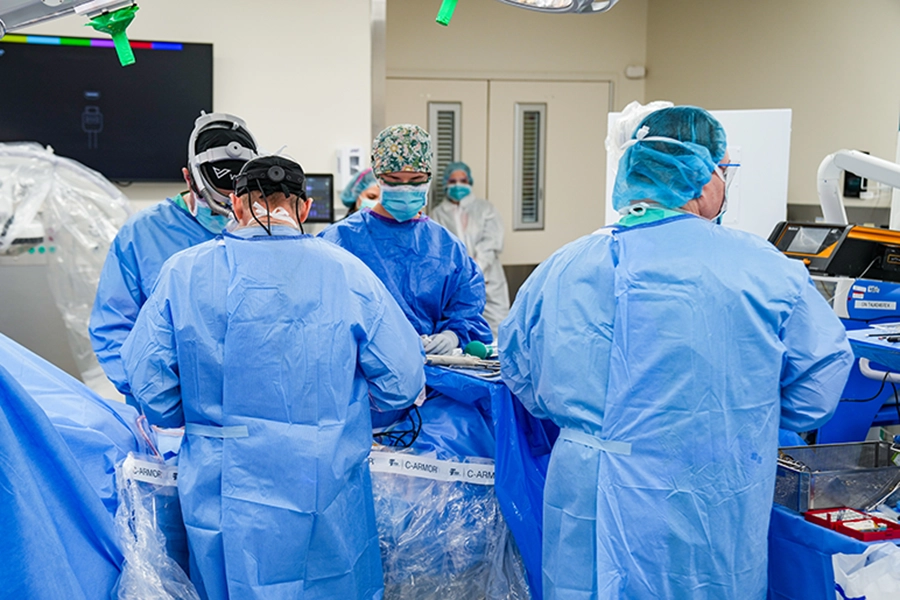
Augmented reality (AR) surgical guidance overlays digital imaging onto the surgeon’s real-time operative view, enabling more accurate implant positioning with less disruption to surrounding tissue. Dr. Jazini pioneered the use of AR in disc replacement surgery at VSI, making VSI among the first in the world to integrate this technology into motion-preserving procedures.
Robotic surgical systems have improved the accuracy of screw and implant placement in complex spinal reconstructions. Custom 3D-printed implants – designed from preoperative imaging to match a patient’s unique spinal anatomy – are another area where VSI has helped push the field forward, particularly in cases where standard implants don’t provide an optimal fit.
VSI has been on the leading edge of robotic-guided innovation in surgery, working with Medtronic in the evolution of multiple robots since 2012. In April 2026, our team performed the world’s first spine surgery with the Stealth AXiS™ Autopilot Robotic System, which is the latest innovation in safer, more precise spine surgery. This next-generation platform integrates AI-powered surgical planning, robotic guidance, optical navigation, and real-time segmental tracking into a single, connected workflow.
Together, these technologies make the outcomes of motion-preserving surgery more consistent, more precise, and more durable over time.
Am I A Candidate For Motion-Preserving Surgery?
The best candidates for motion-preserving spine surgery are typically patients with disc-related pain at one or two spinal levels that have not improved after at least six months of conservative care, with good bone density and no significant spinal instability, deformity, or advanced arthritis at the affected level.
Younger and more active patients tend to benefit most, given the longer functional demand placed on the spine over time. Conditions like severe osteoporosis, multi-level degeneration, or significant spinal deformity may make fusion the more appropriate choice.
Patient selection is as critical as the technology itself. A thorough evaluation – including advanced imaging and an honest conversation with a surgeon experienced in both fusion and non-fusion options – is essential to determining which approach is right for a given individual.
What’s Next in Motion-Preserving Spine Technology
The field of motion preservation is advancing rapidly, with several emerging technologies moving through clinical trials and early adoption that could meaningfully expand who qualifies for a non-fusion approach.
Perhaps the most exciting frontier, however, is biological disc regeneration – the idea that rather than replacing a damaged disc, surgeons may eventually be able to repair or rebuild it using the body’s own healing mechanisms. Many VSI patients have healed their disc issues with Stem Cell Therapy and PRP injections for disc degeneration.
On the surgical technology side, artificial intelligence is beginning to play a role in implant planning and placement precision. AI-assisted tools can analyze preoperative imaging to help surgeons select the optimal implant size and position before ever entering the operating room – a development that could make the already strong outcomes of disc replacement and TOPS™ surgery even more consistent across patients and spinal levels. See how Dr. Jazini combined AI, TOPS™ and ADR in surgery, the first of its kind on the East Coast.
As these technologies mature, the population of patients who can benefit from a motion-preserving approach is expected to grow – and the procedures themselves are expected to become less invasive, more personalized, and more durable over time.
What This Surgical Innovation Means for Patients
The growth of motion-preserving technology represents a genuine shift in spine care – away from a one-size-fits-all approach and toward solutions tailored to each patient’s anatomy, lifestyle, and long-term goals. For patients who have been told fusion is their only option, it is worth seeking evaluation at a center with deep experience in these technologies.
At VSI, preserving motion has been a guiding principle since the practice’s founding. Whether through cervical or lumbar disc replacement, the TOPS™ System, hybrid surgery, or the integration of augmented reality and robotic guidance, VSI’s surgeons are consistently at the forefront of applying these technologies to help patients move better, recover faster, and protect their spinal health for years to come.
If you’re exploring surgical options for neck or back pain, request a consultation with VSI to learn whether motion-preserving technology may be right for you.
Frequently Asked Questions
What is motion preservation surgery in the spine?
Motion preservation spine surgery refers to a category of procedures and implants that treat a damaged or degenerated spinal level while maintaining its natural ability to bend and rotate – as opposed to spinal fusion, which permanently locks two vertebrae together. Common motion-preserving procedures include artificial disc replacement, the TOPS System, and dynamic posterior stabilization.
What is the difference between artificial disc replacement and spinal fusion?
Spinal fusion permanently joins two vertebrae to eliminate movement at a damaged level, which can relieve pain but also restricts flexibility and increases stress on adjacent spinal segments over time. Artificial disc replacement removes the damaged disc and replaces it with a prosthetic implant that allows the spine to continue moving naturally at that level, reducing the risk of adjacent segment degeneration.
Is artificial disc replacement better than spinal fusion?
For the right patient, artificial disc replacement offers significant advantages over fusion – including preserved range of motion, faster recovery, and reduced risk of adjacent segment disease. However, it is not appropriate for everyone. Patients with spinal instability, significant arthritis, osteoporosis, or multi-level degeneration may still be better served by fusion. The best approach depends on individual anatomy, age, activity level, and the specific condition being treated. See a full comparison: Artificial Disc Replacement vs. Spinal Fusion.
What is the TOPS System and how is it different from fusion?
The TOPS™ (Total Posterior Spine) System is an FDA-approved implant for lumbar spinal stenosis with spondylolisthesis – a condition that has traditionally been treated almost exclusively with fusion. Unlike fusion, TOPS replaces the damaged facet joints while allowing controlled motion at the treated level. It received a rare “superior to fusion” designation from the FDA based on clinical trial results.
Who is a good candidate for motion-preserving spine surgery?
Ideal candidates typically have disc-related pain at one or two spinal levels that has not responded to at least six months of conservative treatment, good bone density, and no significant spinal instability, deformity, or advanced arthritis at the affected level. Younger and more active patients often benefit most. A spine surgeon experienced in both fusion and non-fusion options can determine which approach is appropriate after a thorough evaluation, or if a combination of both disc replacement surgery and spinal fusion surgery would benefit the individual the most.
How long does recovery take after artificial disc replacement?
Recovery from artificial disc replacement is generally faster than spinal fusion. Many patients are able to walk the day of surgery and return to light activity within a few weeks. Full recovery varies by patient, spinal level treated, and overall health, but most people return to normal daily activities within six to twelve weeks.
What spine conditions can be treated with motion-preserving technology?
The most commonly treated conditions include degenerative disc disease, cervical or lumbar disc herniation, and lumbar spinal stenosis with spondylolisthesis. The specific technology used depends on the condition, the spinal level affected, and the patient’s overall anatomy and health.
Does VSI offer motion-preserving spine surgery?
Yes. VSI is a nationally recognized leader in motion-preserving spine surgery, including cervical and lumbar artificial disc replacement, the TOPS™ System, hybrid surgery, and dynamic stabilization. VSI surgeons Dr. Haines and Dr. Jazini has performed numerous regional and national firsts in disc replacement and have pioneered the use of augmented reality guidance in motion-preserving procedures.
Topics covered
About the Author
Featured Resources
Insights to Achieve a Pain-Free Life