
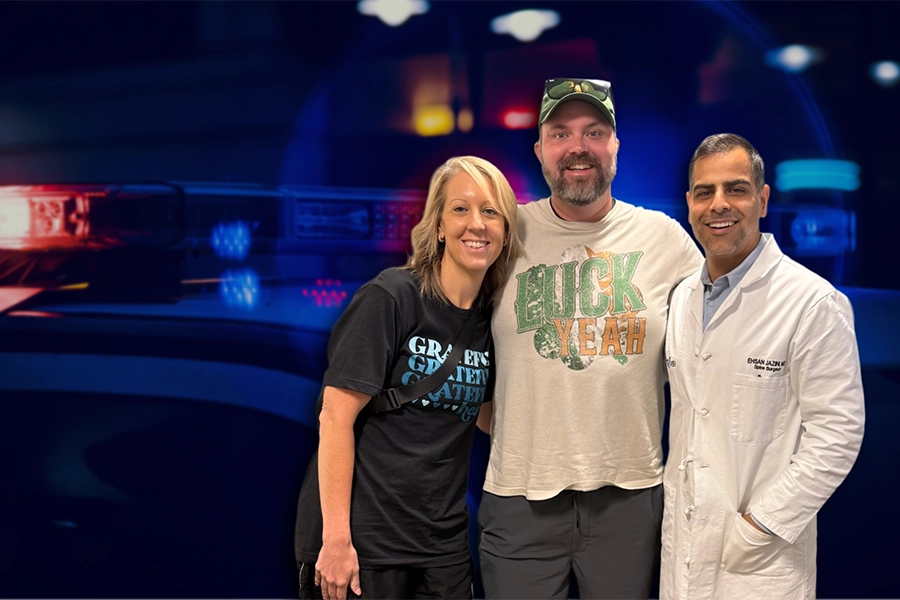
VSI Earns National Recognition on Fox News for Helping Police Officer Overcome Back Injury
Tim had built his life around service, strength, and movement. As a Texas law enforcement officer, former K9 officer, Detective Sergeant, marathon runner, husband, and father, his identity was closely tied to being active and capable. But after a line-of-duty injury in 2017, chronic back and neck pain began taking away the life he knew. Years of pain, delayed answers, prior treatment, and failed relief led him down a path to getting treatment at VSI | Spine Solutions. During National Police Week, Tim’s story was featured on FOX News Live as part of a national spotlight on injured law enforcement officers and the hidden crisis many face after being hurt in the line of duty.
Watch the National FOX Interview on Youtube
Key Takeaways: What Can Patients Learn From Tim’s Chronic Back Pain Recovery?
- Tim, a Texas law enforcement officer, developed severe spine pain after being injured in the line of duty in 2017.
- Before coming to VSI, he had tried physical therapy, medication, injections, and several surgeries elsewhere, but his pain continued to limit his daily life.
- Tim was diagnosed with multiple spine conditions, including lumbar stenosis, disc herniation, radiculopathy, post laminectomy syndrome, cervical radiculopathy, cervical stenosis, cervical disc herniation, thoracic stenosis, and osteopenia.
- Dr. Ehsan Jazini performed a 2-level cervical disc replacement in May 2025, followed by staged 2-level lumbar spinal fusion procedures in June 2025.
- After surgery, Tim returned to work, reconnected with his family, and danced at his daughter’s wedding—something he once feared would be impossible.
How Can a Police Officer’s Back Injury Lead to Chronic Spine Pain?
A police officer’s back injury can lead to chronic spine pain when trauma damages discs, joints, nerves, or spinal structures and symptoms do not resolve with conservative care. For Tim, the injury happened in 2017 while he was working in law enforcement in Texas. He was badly injured on the job after falling during the arrest of a man who was threatening to kill his grandmother.
That moment changed the course of Tim’s life. What began as an on-duty injury became years of disabling back pain, reduced mobility, and uncertainty about whether he would ever feel like himself again. Before coming to VSI, Tim tried physical therapy, medication, injections, and several surgeries elsewhere, but his symptoms continued to interfere with walking, working, and being present with his family.
What Happens When Chronic Back Pain Affects Work, Family, and Mental Health?
Chronic back pain can affect work, family life, mobility, independence, and mental health. In a recent study on back pain by Annals of Neurology, chronic back pain can even effect how unpleasant sounds are processed in the brain. For Tim, pain was not just a symptom on an imaging report. It changed how he moved through the world and how he participated in the moments that mattered most for his family.
Dr. Jazini described the impact clearly in the FOX5 interview: “It wasn’t just affecting his physical health, but also his mental health.” He added that Tim’s daughter was about to get married and “he had lost hope.”
Before surgery, Tim described being limited to the couch while trying to play with his son indoors. “I had to sit on the couch and throw a ball inside the house with my son,” Tim said. After treatment, he said, “we can actually get back out and do things as a family.”
Watch the Fox5 Segment on Youtube
Treatment After Failed Back Surgery Syndrome (FBSS)
The Wounded Blue connected Tim with Dr. Ehsan Jazini at VSI after years of pain and barriers to getting the spine care he needed, and to find relief after failed spine surgeries. The Wounded Blue is a nonprofit dedicated to helping injured law enforcement officers access medical support when they have been hurt in the line of duty.
At the time of his first appointment with Dr. Jazini, Tim had undergone multiple back surgeries that had failed to provide him with pain relief, often called failed back surgery syndrome, or FBSS. This is largely attributed to fragmented care and the quality of care that Tim was receiving from his previous providers. The VSI model is able to look at the full picture and use expertise from a wide range of providers—including other spine surgeons, pain management doctors, spine-specialized physical therapists, and physiatrists—all under one roof.
Dr. Jazini has cared for police officers, first responders, military veterans, and other patients whose injuries affect not only their bodies, but also their identity, career, and family life. In Tim’s case, the goal was not simply to perform surgery. The goal was to help him regain the life that chronic spine pain had taken from him.
Watch Dr. Jazini Explain Failed Spine Surgery
What Spine Conditions Was Tim Diagnosed With Before Surgery?
Tim was diagnosed with multiple spine conditions across the cervical, thoracic, and lumbar spine. His lumbar diagnoses included spinal stenosis, disc herniation, radiculopathy, and post laminectomy syndrome. His cervical diagnoses included radiculopathy, stenosis, and disc herniation. He was also diagnosed with thoracic stenosis and osteopenia.
These diagnoses helped explain why Tim’s pain was so persistent and why a personalized surgical plan was needed. When spine pain involves multiple regions, prior surgery, nerve symptoms, and reduced bone density, treatment planning requires a detailed understanding of both the patient’s anatomy and the life they want to return to.
What Is Lumbar Spinal Stenosis?
Lumbar spinal stenosis is a narrowing of the spinal canal in the lower back. This narrowing can place pressure on spinal nerves and may cause low back pain, leg pain, numbness, weakness, or difficulty walking and standing.
What Is a Lumbar Disc Herniation?
A lumbar disc herniation occurs when disc material in the lower back pushes out of its normal position. If the herniated disc compresses or irritates a nearby nerve, it can cause lower back pain, shooting leg pain, numbness, tingling, or weakness.
What Is Lumbar Radiculopathy?
Lumbar radiculopathy is nerve pain that starts in the lower spine and travels into the buttock, leg, or foot. It is often caused by nerve compression from conditions such as spinal stenosis or disc herniation.
What Is Post Laminectomy Syndrome?
Post laminectomy syndrome refers to persistent or recurrent pain after a previous spine surgery. Patients with this condition often need a careful second opinion to identify whether pain is coming from nerve compression, instability, scar tissue, adjacent-level disease, or another spine-related cause.
What Is Cervical Radiculopathy?
Cervical radiculopathy is nerve pain that begins in the neck and can travel into the shoulder, arm, or hand. It may be caused by a cervical disc herniation, cervical spinal stenosis, or another condition that irritates or compresses a nerve root in the neck.
What Is Cervical Spinal Stenosis?
Cervical spinal stenosis is narrowing of the spinal canal in the neck. This narrowing can place pressure on the spinal cord or nerve roots and may cause neck pain, arm pain, numbness, tingling, weakness, balance changes, or coordination problems depending on severity.
What Is a Cervical Disc Herniation?
A cervical disc herniation occurs when disc material in the neck moves out of its normal position and irritates or compresses nearby nerves. This can lead to neck pain, arm pain, numbness, tingling, or weakness.
What Is Thoracic Stenosis?
Thoracic stenosis is narrowing of the spinal canal in the mid-back. While less common than cervical or lumbar stenosis, thoracic stenosis can contribute to pain, nerve symptoms, walking difficulty, or spinal cord-related symptoms depending on the degree and location of compression.
Why Does Osteopenia Matter Before Spine Surgery?
Osteopenia matters before spine surgery because bone density can influence surgical planning, implant selection, fusion strategy, and recovery. Osteopenia means bone density is lower than normal, which makes it important for the surgeon to account for bone quality when creating a safe and effective treatment plan.
What Spine Surgeries Restored Tim’s Life?
Dr. Ehsan Jazini performed a 2-level cervical disc replacement followed by a staged 2-level lumbar fusion. This plan addressed both Tim’s neck and lower back conditions. Because Tim had symptoms across multiple regions of the spine, his treatment required a strategic, staged approach designed around his diagnoses, prior treatment history, and goals for recovery.
Two-Level Cervical Disc Replacement
A 2-level cervical disc replacement is a motion-preserving neck surgery that removes two damaged cervical discs and replaces them with artificial discs. The goal is to relieve pressure on affected nerves while preserving motion at the treated levels. For patients with cervical disc herniation, cervical stenosis, or cervical radiculopathy, disc replacement may be considered when symptoms persist despite appropriate nonsurgical care and imaging confirms the source of nerve compression.
Two-Level Lumbar Fusion
A 2-level lumbar spinal fusion is a lower back surgery designed to stabilize two painful or unstable spinal segments. The goal is to reduce pain, improve stability, and relieve nerve pressure when compression is contributing to symptoms. For Tim, lumbar fusion was part of a broader plan to address chronic lower back pain, lumbar stenosis, lumbar disc herniation, radiculopathy, and persistent pain after prior spine surgery.
Why Would a Patient Need Both Neck and Lower Back Surgery?
A patient may need both neck and lower back surgery when clinically significant spine conditions affect more than one region and each area contributes to symptoms. In Tim’s case, he had diagnoses in the cervical spine and lumbar spine, along with thoracic stenosis and osteopenia. Not every patient with pain in multiple areas needs multiple surgeries. At VSI, this decision depends on a detailed evaluation of symptoms, imaging, physical exam findings, prior treatment, overall health, and the patient’s goals for life after treatment.
Why Is an Accurate Spine Diagnosis Important for Chronic Back Pain Treatment?
An accurate spine diagnosis is important because chronic back pain can come from many different sources, including discs, nerves, joints, muscles, bones, failed prior spine surgery, or a combination of problems. Treating the wrong source of pain can lead to continued symptoms and frustration.
At VSI, the process begins with understanding the patient’s full story: how the pain started, where symptoms travel, what treatments have already been tried, what imaging shows, and what the patient wants to get back to. For Tim, the diagnosis-driven plan helped transform a years-long struggle into a recovery story centered on mobility, family, and hope.
When Should Someone With Chronic Back Pain Get a Second Opinion?
Someone with chronic back pain should consider a second opinion when pain continues despite physical therapy, medication, injections, or prior spine surgery. A second opinion may also be helpful when pain limits walking, work, sleep, family life, or independence. Tim’s story shows why this step can be so important. He had already tried multiple treatments before The Wounded Blue connected him with Dr. Jazini and VSI. A second opinion helped identify the conditions contributing to his pain and created a treatment plan designed around his specific anatomy and goals.
Can Spine Surgery Help Patients Return to Work and Family Life?
Spine surgery can help patients return to work and family life when surgery is matched to the right diagnosis and the patient’s symptoms are caused by a treatable structural spine problem. Surgery is not the first step for every patient, but it may be considered when pain persists despite appropriate non-surgical care and imaging confirms the source of symptoms.
For Tim, recovery meant more than walking with less pain. It meant returning to work as a deputy with the Wichita County Sheriff’s Office. It meant getting out of the house again. It meant playing baseball with his son. It meant showing up for his family in ways chronic pain had made impossible.
Tim described the transformation this way: “The Wounded Blue and Dr. Jazini has completely changed my life. My family’s life.” He shared that he was no longer confined to the house and could “get back out and do things as a family.”
How Did Tim Go From Severe Back Pain to Dancing at His Daughter’s Wedding?
Tim went from severe back pain to dancing at his daughter’s wedding after The Wounded Blue connected him with Dr. Jazini and VSI, where he received a diagnosis-driven surgical plan for complex cervical and lumbar spine conditions. Before surgery, that wedding moment felt uncertain. After surgery, it became one of the defining images of his recovery.
For years, pain had narrowed Tim’s life. The dance floor represented something bigger than a single event. It represented standing, moving, celebrating, and being fully present for his daughter and family after years of pain and limitation. The FOX5 report highlighted how life-changing the right spine care can be for patients who have lost hope.
Watch Tim and Dr. Jazini on the VSI Podcast:
What Should Patients Do If Back Pain Treatment Has Not Worked?
Patients should seek a specialist evaluation if back pain treatment has not worked, especially when symptoms persist after physical therapy, medication, injections, or prior surgery. Ongoing pain may mean the original diagnosis needs to be revisited, the pain generator has changed, or a more advanced treatment option should be considered.
If you have been told surgery is not possible, bounced between providers without answers, or simply are not getting better, a second opinion can provide clarity. At VSI, patients travel from across the country and around the world for expert diagnosis, advanced surgical options, and treatment plans built around their lifestyle, not just their imaging.
FAQs About Chronic Back Pain, Spine Surgery, and Second Opinions
Can chronic back pain affect mental health?
Yes. Chronic back pain can affect mental health by limiting mobility, independence, work, sleep, and family participation. Dr. Jazini noted that Tim’s condition was affecting both his physical health and his mental health before surgery.
What is cervical disc replacement surgery?
Cervical disc replacement surgery is a motion-preserving neck surgery that removes a damaged cervical disc and replaces it with an artificial disc. Tim underwent a 2-level cervical disc replacement with Dr. Jazini in 2025.
What is lumbar fusion surgery?
Lumbar fusion surgery is a lower back procedure that stabilizes one or more painful or unstable spinal segments. Tim underwent staged 2-level lumbar fusion procedures in 2025.
Can patients travel to VSI from out of state?
Yes. Patients travel to VSI from across the country for evaluation and treatment. Tim first connected with Dr. Jazini virtually before traveling from Texas to VSI for in-office evaluation and surgical care.
What if physical therapy, injections, medication, or prior surgery did not work?
If physical therapy, injections, medication, or prior surgery did not work, a second opinion may help identify the true cause of persistent pain and determine whether additional treatment options are appropriate. Tim had tried multiple treatments before The Wounded Blue connected him with Dr. Jazini and VSI.
Topics covered
About the Author
Featured Resources
Insights to Achieve a Pain-Free Life