
From Chronic Back Pain to Professional Tennis: A Bertolotti Syndrome Comeback
Key Facts
- Dilhan Wasantha was the UK’s number one ranked junior tennis player before Bertolotti syndrome sidelined his professional dreams.
- After years of unsuccessful treatments, Dilhan traveled from the UK to VSI in Reston, Virginia, seeking answers from spine surgeon Dr. Colin Haines.
- A minimally invasive, motion-preserving Bertolotti resection helped Dilhan avoid spinal fusion.
- Following a personalized recovery program, Dilhan returned to competitive tennis and entered his first professional tournament.
For Dilhan Wasantha, tennis was more than a sport. It was the future he’d spent his entire life working toward. But just as the UK’s top-ranked junior tennis player was preparing to turn professional, debilitating back pain and nerve pain down his legs brought his dreams to a halt.
What began as pain on the court eventually took away his ability to exercise, coach while standing, or enjoy everyday activities. Despite having a diagnosis of Bertolotti syndrome, Dilhan spent years searching for a treatment that could give him his life back.
Today, he’s back on the court pursuing a professional tennis career after traveling from the UK to VSI in Reston, Virginia, for a personalized, motion-preserving spine surgery with Dr. Colin Haines.
Watch Dilhan and Dr. Haines share his recovery journey on the Get Back to Your Life® podcast below:
Why Is Bertolotti Syndrome So Difficult to Diagnose and Treat?
Bertolotti syndrome is a spinal condition involving an anatomical variation at the base of the lumbar spine, where an enlarged transverse process may form an abnormal connection with the sacrum. For some patients, this can cause painful bone-on-bone contact, restricted motion, and chronic lower back pain.
As Dr. Haines explains, not everyone with this anatomical variation experiences symptoms. That makes identifying the true source of pain particularly challenging, even when imaging reveals the condition. For Dilhan, getting a diagnosis was only the beginning. Physical therapy, steroid injections, radiofrequency ablation, and other treatments failed to provide lasting relief. He and his father searched for specialists across Europe and Asia, but struggled to find someone with experience treating his condition.
“I got so used to the pain because I got so used to managing it as well. It just became my day to day life,” Dilhan shares.
Everything changed when he discovered a video featuring Dr. Haines discussing Bertolotti syndrome with another patient on Fox5.
How Did Dilhan Find a Path Back to Professional Tennis?
From his first virtual consultation with VSI, Dilhan noticed something different. Rather than focusing solely on his imaging, Dr. Haines and his team wanted to understand his complete medical history, symptoms, and goals. For Dilhan, that goal was clear: return to professional tennis.
Given his age, anatomy, and athletic aspirations, Dr. Haines recommended a minimally invasive Bertolotti resection rather than spinal fusion. The procedure removes the abnormal bone responsible for painful contact while preserving motion in the spine, an especially important consideration for an elite athlete whose sport demands flexibility, rotation, and explosive movement. As Dr. Haines explains in the episode, removing the painful bone can restore some motion while dramatically improving symptoms. But surgery was only one part of Dilhan’s personalized recovery roadmap.
What Is Recovery Like After Bertolotti Syndrome Surgery?
Dilhan’s recovery wasn’t an overnight transformation. It was a gradual process of rebuilding strength, confidence, and the ability to trust his body again. Working with VSI physical therapist Larry Grine, he started with foundational core exercises, including five-second planks and controlled squats. After approximately two to three months, he began returning to the tennis court in five-minute increments.
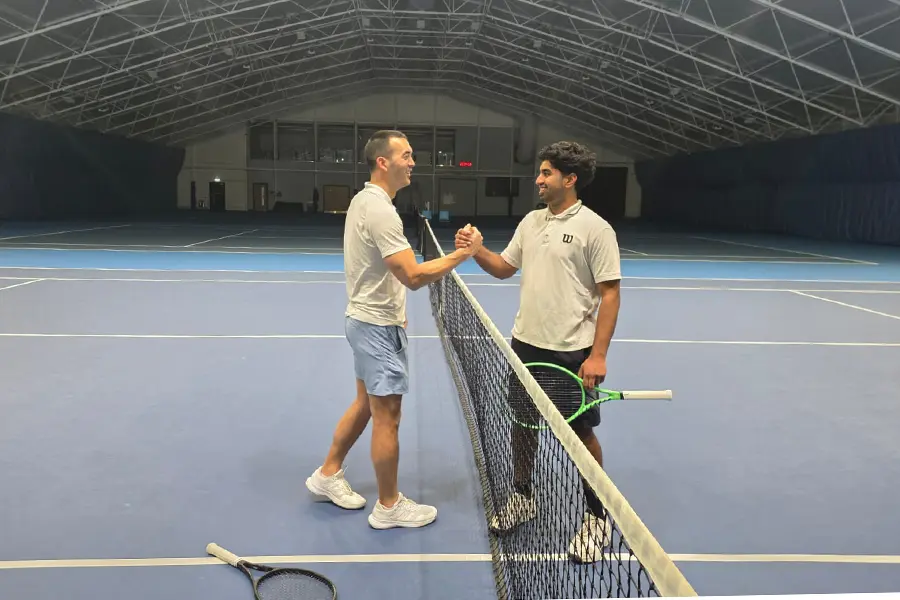
By six months after surgery, Dilhan was playing tennis for approximately 30 minutes three times per week. That same month, he stepped onto a court in London with Dr. Haines for a friendly match, a milestone neither had taken for granted. Recovery also came with challenges. Dilhan experienced periods of discomfort that reminded him of his preoperative symptoms, making it difficult to know when to advance his activity. With continued rehabilitation, he gradually increased his tolerance and returned to competition.
“I had a new version of a hundred percent each time I played,” Dilhan explains, describing how his abilities continued improving as he progressed through recovery.
His experience is an important reminder that recovery isn’t always linear. The pace and outcomes of Bertolotti surgery depend on each patient’s condition, treatment, and individual goals.
Reclaiming Lost Moments in Life
One of the most powerful measures of Dilhan’s recovery had nothing to do with tennis.
Two days before surgery, he visited a museum in Washington, DC, where his pain forced him to constantly search for somewhere to sit. Approximately one year later, he visited the British Museum in London and spent four hours walking without needing to sit down. By the time of the podcast recording, Dilhan had returned to professional tennis competition, traveling to Tunisia for his first professional tournament. While his ambition is to compete at the highest level, his story represents something bigger than athletics: getting back to a life no longer dictated by pain.
Dr. Haines emphasizes that every patient’s goals matter, whether that means competing professionally, walking comfortably, or picking up a child or grandchild.
“The biggest thing is getting back to the life that you want to have,” says Dr. Haines.
Finding Hope When Other Bertolotti Syndrome Treatments Have Failed
Dilhan found VSI because another Bertolotti syndrome patient shared their story. Now, he’s documenting his own recovery journey to help others searching for the answers he once needed. For patients living with unexplained chronic back pain or struggling to find relief after a Bertolotti syndrome diagnosis, his experience highlights the importance of seeking a specialist who understands the condition and the full range of treatment options.
At VSI, our approach to complex spine conditions goes beyond identifying a diagnosis. We develop personalized treatment and recovery plans centered on each patient’s anatomy, symptoms, and goals. Whether your goal is returning to competitive sports or simply moving through life without debilitating pain, finding the right path forward begins with understanding what matters most to you.
Still searching for answers? Schedule a consultation with VSI to explore your options for Bertolotti syndrome treatment and take the next step toward getting back to your life.
Topics covered
About the Author
Featured Resources
Insights to Achieve a Pain-Free Life